Saturday, 10 March 2018

I, Tonya

(Warning: contains spoilers for I, Tonya)

It's taken a while to write this review, because I'm still not sure what I've watched and what I make of it.  Like The Usual Suspects it's not until you get to the ending that you realise that you're no further forward in fully understanding what exactly has gone on.

In real life, Tony Harding is an Olympic figure skater who (amongst other figure skating firsts) became the first American woman to successfully complete a triple axel jump in competition.  She was also, in some way, involved in an attack on Nancy Kerrigan - her team mate and rival.  This much is true.
Film is called I, Tonya.  That's definitely
true as well.
The film, I Tonya, is a fourth wall breaking, documentary style drama, with interviews from Tonya (Margot Robbie), her mother LaVona (Allison Janney), Tonya's ex-husband Jeff Gillooly (Sebastian Stan) and his friend Shawn Eckhardt (Paul Walter Hauser).  The story is about Tonya's figure skating career up until the immediate aftermath of the attack on Kerrigan, intercut with each character's recollections, contradictions and commentary on that footage.  Ice based drama ensues.

It's a difficult watch.  Where the trailer suggested a light and breezy account of a tough young woman overcoming the odds and winning over her critics, the truth is that there's little light and breezy about it.  It's a difficult watch as Tonya is repeatedly abused both verbally and physically, first by her mother and then by her husband.  By the end of the film we have watched her being struck repeatedly, stabbed and shot.  The hurdles are numerous - from the figure skating judges who are dismissive of her rock routines and rhinestones for not being "feminine" enough, to the authorities who seem uninterested in the crying, bleeding woman in the car as her husband is pulled over for speeding and don't seem to follow up on the repeated breaches of restraining orders.  Even her skating coach seems to ignore the fingerprint welts on Tonya's arms and yet another black eye.  Margot Robbie's prickly performance makes one thing clear - Tonya Harding can't win.  Everything is too stacked against her.  So she becomes difficult, and unlikeable, and abrasive.  And the hurdles get higher. After the Kerrigan attack, she is given 3 years probation, 500 hours community service, a $100,000 fine, stripped of her figure skating titles and banned for life from participation in figure skating in any form.  Comparatively, Eckhardt served 14 months in prison.  Gillooly served 2 years.  An incredulous Tonya notes, "Nancy gets hit once and the whole world shits.  For me, that's an everyday occurrence."

So what makes the difference?  Is it because she's a woman?  Partially - note the disparity in punishments between the men (who were there and carried out the attack) and Tonya (who wasn't there but may have been involved in some form of conspiracy).  Is it because she's not considered conventionally feminine?  Partially - "we also grade on presentation" notes a judge, evaluating Tonya's handmade costumes, meaning that although Tonya is technically the better skater, Kerrigan's artistic interpretation counts for more.  It's not enough to be good enough - you have to be pretty while you're doing it.  "She looks as though she chops wood every morning" notes one detractor.  "That's because she does chop wood every morning" snaps her mother.  Is it because nobody wants to be on her side because her mother makes it impossible to be friends with Tonya?  Partially - "Don't talk to her" yells LaVona at 4 year old Tonya.  "She's not your friend, she's your competitor".  Which seems to be how LaVona sees everyone in the world.  Is it because she's poor?  Partially - as Tonya is widely mocked for her fitness routine largely based on the montage from Rocky IV.  All of these things and more make Tonya Harding unlikeable to the outside world.  The world does not root for an unlikeable person.  The world generally tries not to engage with an unlikeable person.
No Tonya, you look fine...
And what of Tonya's abusers - what do they have to say for themselves?  That's an interesting series of interviews.  Gillooley carefully notes that Tonya didn't always tell the truth.  LaVona ignores all charges put against her and instead notes that her treatment of Tonya is what made her a winner.  "Tonya does best when she's angry" she claims, paying a stranger to hurl abuse at her daughter as she enters the ice rink for her latest competition (which Tonya goes on to win).
"And you", spits Tonya as she directly addresses the audience - "you're all my attackers too" - a charge that should have cut deep, after a lot of tonal flipflopping, and a shaky script is a bit of a jump that doesn't quite land.
I can't quite place why it doesn't quite work for me.  The constant fourth-wall breaking gets distracting, and breaks the tension rather than building it.  We don't see enough of Tonya in relation to the figure skating world, so it never really seems like she's out of place until someone deliberately says that she is.  And although we see the struggle of her relationships, we don't see the value of anything - we can't fully grasp that figure skating is her absolute everything until it is taken from her and Robbie has to painstakingly explain the consequence and unfairness of that to the audience.  And although we're invited to laugh along, we're mainly laughing at the horror of Tonya's situation, which is part of the issue to begin with.

The acting, particularly by Robbie and Janney needs to be commended.  Robbie plays a fine line of making Tonya as brash and sharp as possible, while making it possible to still root for her.  When Tonya is happy the audience is happy.  Janney is entirely deserving of her Best Supporting Actress Oscar, and the closing shots of the real LaVona in her fur coat wearing, chain smoking, bird-toting glory are a sudden shocking realisation that Janney has turned in a note-perfect performance.  A sharper script would have helped this score higher for technical merit, but the artistic interpretation by the female leads are the real crowd pleasers.
Scary birds
Additional thoughts, questions, comments:

  • Are we laughing with Tonya?  Or at her?  Or both?
  • LaVona's bird - that really deserves to win some sort of acting Oscar (which actually exist - they're called the Pawscars)
  • I wonder what Nancy Kerrigan's take on this is - hers is a voice oddly missing from the film.

Tuesday, 6 March 2018

Black Panther

(Warning: contains spoilers for Black Panther, Wonder Woman and general MCU)

Something new from the MCU - a film where the main protagonist isn't a white man.  Gadzooks, what is this brave new world?
Black Panther
Black Panther is set in Wakanda, a nation composed of 5 tribes in Africa built on meteorite called Vibranium.  With Vibranium, they advance in terms of technology, but disguise themselves as a Third World country in order to protect what they have.  King T'Chaka's (John Kani) death leads to the throne being taken by his son T'Challa (Chadwick Boseman).  He is challenged by Killmonger (Michael B. Jordan), who provides a legitimate claim to the throne and gathers the support of a number of T'Chaka's key allies.  Power struggles ensue.
  
Black Panther, by its very existence, is going to have similar scrutiny levelled at it as Wonder Woman did last year.  Where Wonder Woman was the first non-male in a lead role (in either DC or MCU), Black Panther is the first* superhero film in the MCU to feature a black lead and predominantly black cast (apart from the Tolkien white guys Martin Freeman and Andy Serkis, and Stan Lee who turns up in a film as a stamp of MCU authenticity).  It's been a long time coming.  Wesley Snipes has been talking about trying to make a Black Panther movie since 1992.  Indeed, in 2005, the CEO of Marvel announced that Black Panther was one of ten Marvel films to be developed by the studio.  Over the past 12 years, it would seem that the film has been offered to various writers and directors (including John Singleton, Mark Bailey and Ava DuVernay) who have played with the idea and passed on it, perhaps not relishing the idea that all cultural expectation would weigh heavily on whoever made this film.

The final film was written by Joe Robert Cole (The People Vs OJ Simpson) and co-written and directed by Ryan Coogler (Creed), who accepted on the proviso that he could bring his own collaborators from different previous projects, rather than relying on the "in-house" Marvel creative team.

The result is glorious.  Having seen this film once, I already feel as though these are characters I have known for longer.  Each is well developed and realised, so that the decisions they have to make have weight and consequence.  Each has a distinct style and tone, which means that already the film has been embraced by fans and cosplayers (imperative in the geek culture).  Letitia Wright (Shuri) has been particularly singled out for praise as a teenage version of Bond's Q, but praise has generally been effusive for all the cast.

As with Spiderman: Homecoming before it, (and with a number of films already released in 2018), there was no real thing as the "good guys" and the "bad guys".  Both sides had their strengths and weaknesses, and both sides were understandable, which made tensions between lovers W'kabi (Daniel Kaluuya) and Okoye (Danai Gurira), or friends W'kabi and T'Challa more resonant.
A thing that I was particularly pleased about is that although the final battle did involve punching each other stupid, there were distinct boundaries at play so there was a real understanding of how this battle could be won and lost (Shuri used the underground trains to disrupt the Vibranium in the suits, so that T'Challa and Killmonger would be both be vulnerable when the trains were going past and could be harmed).  This is at real odds with most other superhero films where the bad guy dies for no other reason than because the script says so.

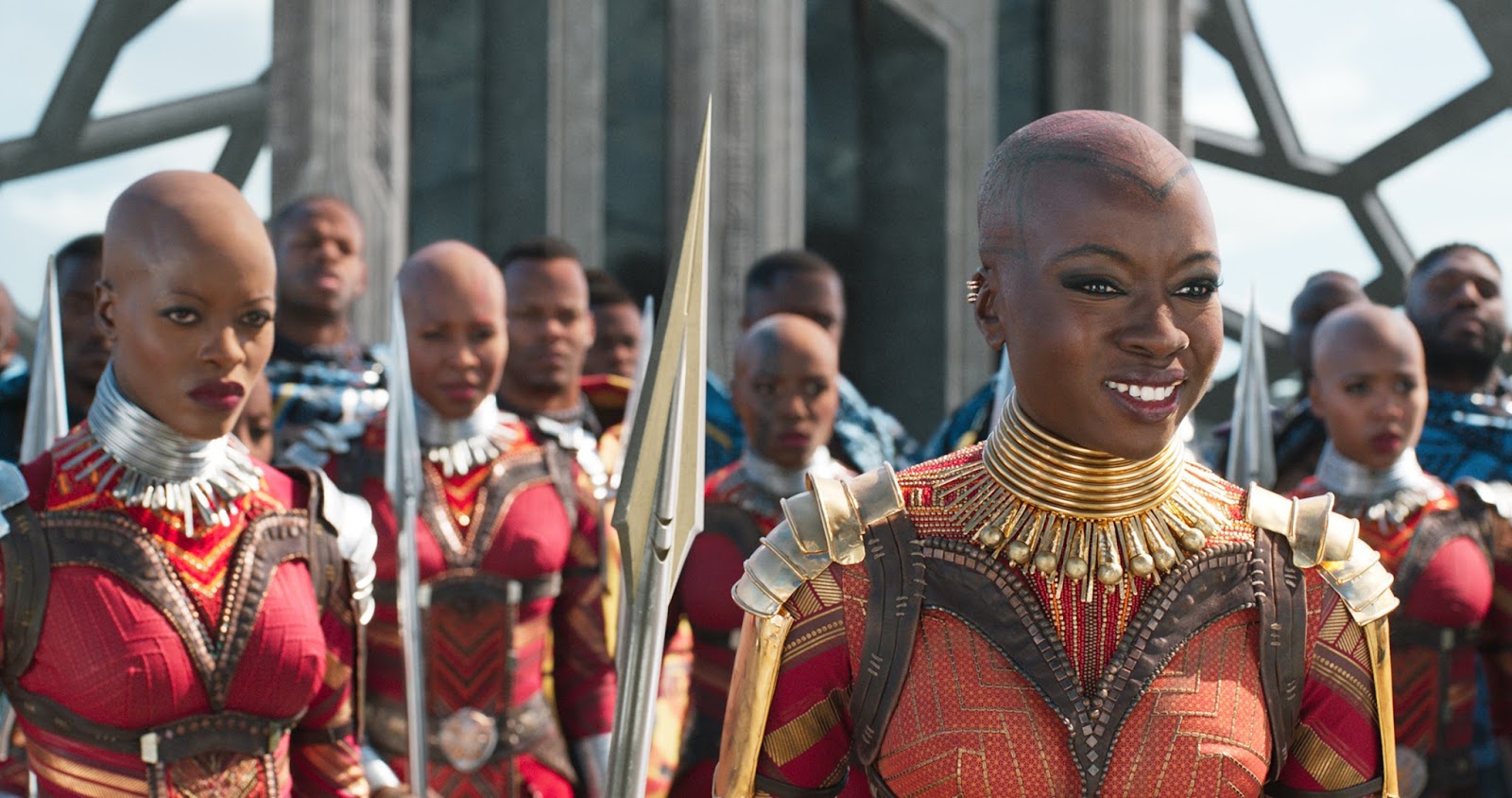
In terms of diversity, Black Panther is notable not only for it's portrayal of non-white culture, but also for it's portrayal of women.  From the Dora Milaje (the all female army of Wakanda) to Shuri, from Nakia (Lupita Nyong'o) to Ramonda (Angela Bassett) these women are strong, smart and fierce, but also independent individuals drawn as separate unique people (rather than just some female bums on seats, filling up the ranks). 
Are you excited and a bit frightened?  That is the correct response.
In thinking about it, there's a load of inclusivity and a good chance that most people can find someone to identify with.  Man? Woman? Disabled? Able bodied? Tattooed? Ink free? Scarred? Unblemished? Bald? Hirsute? Masculine? Feminine? Androgynous? There's someone for everyone.  I have seen some criticism that a potential gay storyline (between Okoye and Ayo) wound up on the cutting room floor, which is reasonable in some ways.  In other ways, sexuality can be found in the subtext if you're looking for it - in the same way it can be found in Top Gun.  And although it is definitely a film representing black culture and black experience, it is not done in a way to make it isolating.  If anything, it feels welcoming and inclusive. 
Take my breath awaaaaaay... 
The concern and scrutiny now turns to Avengers: Infinity War.  The MCU have their own raft of usual writers, directors and producers which now must work with the Black Panther team to produce something that best serves both (or risks undoing all the good feeling that Black Panther has brought to the predominantly white, male MCU).  Black Panther and Wonder Woman have both proved there is a huge market and interest in non-white, and non-male leads and stories.  In the time it's taken you to read this review, Black Panther has probably made another eleventy million pounds (as of 5th March, it's grossed $899.9 million and is the fastest Marvel film to reach the $50 million mark).  No pressure, MCU, but Wakanda forever! 

Additional thoughts, questions and comments:
  • So...all the heart shaped herbs are now gone, we assume?  How does the next Black Panther get their superpowers?
  • Killmonger specifically states that each of the marks on his body represents someone that he's killed.  Is that specific to him, or is that what all those marks mean?  W'kabi has the same marks on his face, but do they represent people he's killed?
  • Is it...a bit like The Lion King?
* Blade doesn't count.  Not in the MCU.  Sorry.

Sunday, 4 March 2018

Oscar predictions 2018

Evening all

Well, no one could really have predicted the Envelopegate of 2017's Academy Awards, but I imagine this year's awards will have their own upsets.  I've seen as many of these as I can, and as such, here are my predictions.

Best Actor in a Leading Role
Gary Oldman - Darkest Hour

This one is pretty much nailed on.  Oldman has won every Best Actor gong going for his portrayal of Winston Churchill, and rightly so.  Sorry everyone else.  Not your year.

Best Actress in a Leading Role
Frances McDormand - Three Billboards Outside Ebbing, Missouri

This seems pretty certain too.  Great portrayal of Mildred Hayes, left grieving and seeking justice after the murder of her daughter.  Multi faceted character piece with no definitive rights or wrongs, and no easy solutions.  Some competition from Sally Hawkins in The Shape of Water as the mute Elisa Esposito, but I think this performance secures McDormand's second Oscar.

Best Actor in a Supporting Role
Sam Rockwell - Three Billboards Outside Ebbing, Missouri

Tough call between him and Woody Harrelson, but Rockwell edges it for exactly the same reasons as Frances McDormand.  Honourable mention for Christopher Plummer as a short notice replacement for Kevin Spacey in All the Money in the World.

Best Actress in a Supporting Role
Allison Janney - I, Tonya

Still getting my head around this film, but an absolutely vile performance from Allison Janney as the needling, abusive, bitch of a mother in I, Tonya.  Sorry Octavia Spencer - just edged out of this one.

Best Director
Guillermo Del Toro - The Shape of Water

For a film that goes into the Oscars with the most nominations this year, I don't think it will go home with many, but I do think it will get one of the Big Five.  Specifically, Best Director.  Every scene of that film is like a work of art.

Best Film Editing
Baby Driver

Typically Edgar Wright, the film is so precise.  Milliseconds faster or slower and this film would have been awful, but the editing in Baby Driver is both a science and an art.

Best Music (Original Score)
Alexandre Desplat - The Shape of Water

Best Music (Original Song)
I want it to be Remember Me from Coco, but I think it might go to This is Me from The Greatest Showman.

Best Writing (Adapted Screenplay)
Call Me By Your Name

Best Writing (Original Screenplay)
Three Billboards Outside Ebbing, Missouri 

Best Animated Feature Film
Coco

I'd like to think that Blade Runner 2049 will pick up pretty much all the technical awards, as some sort of apology for the fact that the film itself isn't recognised for Best Film.

Leaving...Best Picture
Oh this is a tough one.  The two main contenders seem to be Three Billboards and The Shape of Water.  Between those two, Three Billboards edges it.  But...but...the Best Picture winners of the 2010s have more often than not been a surprise.  Moonlight won over La La Land, Spotlight won over The Revenant, Argo won over Lincoln, Birdman won over Boyhood.
I don't think it's Phantom Thread, Call Me By Your Name, Lady Bird, Dunkirk or Darkest Hour.
Horror films and fantasy don't win - the only exception to this has been The Return of the King.  So that should rule out The Shape of Water and Get Out.  But Get Out is having a resurgence in popularity, despite coming out well before awards season started.  And it did win the Film Independent Spirit Award - which has correctly predicted the Best Picture for the past four years.

I want The Post to win, and it should if the Academy want to make a political point.  But Best Picture is the only category which is decided by a First Past The Post voting system, which makes a winner by consensus trickier.  That said, it is a film about how the media are ace, and the Academy is a bit of a sucker for that.

Right.  Conclusions.  And these are surprising me even as I type...
Should win: The Post
Will win: I think it might be Get Out.

Gosh.  I'd have voted three times if I could...

Sunday, 18 February 2018

The Shape of Water

(Warning: contains spoilers for The Shape of Water)

It's getting closer to the Oscars and one of the big contenders is The Shape of Water, leading with 13 nominations.  Four of those are for "The Big Five" (Best Actor, Actress, Picture, Director and Screenplay - The Shape of Water does not have a nomination for Best Actor).  As a result of this, and as a result of its frankly beautiful trailer, I have been keen to see this for some time.
The Life Aquatic...?
Admittedly, the premise - woman falls in love with sea creature - is not typical movie fare, and certainly not typical Oscar movie fare.  So what makes this different?

Good question.  This is a Guillermo del Toro film, so from the outset it can be assumed that this is a fairy tale featuring monsters (as per Pan's Labyrinth).  As per all fairy tales about monsters, it can also safely be assumed that the monster is probably not the thing that looks like a monster.  It's probably closer to the thing that looks like us.  Or, if it's a film with Michael Shannon in it, it's probably Michael Shannon.  Del Toro has credited some of the inspiration for this film from Creature from the Black Lagoon, but there's also touches of Splash, Amelie, and Buster Keaton/Charlie Chaplin throughout.

The film is told by Giles (Richard Jenkins), a struggling, gay, alcoholic illustrator.  It is about his next door neighbour, Elisa Esposito (Sally Hawkins) - a mute janitor who cleans at a government facility in Baltimore.  One day, a creature (played by Doug Jones) is brought to the facility.  Over time, Elisa develops a relationship with the creature who is being mistreated by the programme director (Michael Shannon).  She begins to plan to help the creature escape.  Aquatic adventures ensue.

The film itself is beautiful.  Set at some point in the early 1960s, it opens with a completely underwater sequence which positions Elisa as a fairytale princess living above a theatre, before draining all the water completely and setting about efficiently sketching Elisa's life - masturbation, eggs, sandwiches, musicals with Giles and working with Zelda (Octavia Spencer).  The colour palette morphs from greens and blues (and teal) to splashes of red when Elisa begins her relationship with the Amphibian Man (that's what's he's called in the credits, so I'll go with that), a fact that was completely lost on my colour-blind husband, who unfortunately perceived the film in mainly sepia tones.  The Amphibian Man himself is quick to light up like a Christmas tree (literally) as soon as he is shown affection.  They literally bring more colour into each others lives.
In direct contrast, it's also worth mentioning the large dollop of body horror in the film too - from Strickland's rotting fingers, to Hoffstetler (Michael Stuhlbarg) having a hole shot in his face, there's a lot to be grossed out by.  There are bits that are definitely not for the squeamish.
Not Abe Sapien.  Definitely not Abe Sapien.
I have read a couple of reviews which have described the relationship between Elisa and the Amphibian Man as that of two outsiders who find love.  I have mixed feelings about this.  In some ways, Elisa can be seen as an outsider because of her muteness.  Similarly, Zelda is an outsider because of her colour, Giles is an outsider because of his sexuality, Hoffstetler is an outsider because he is not American (and the Amphibian Man is an outsider because of not being human).  But Elisa doesn't seem to be lacking anything - she seems content with her life, her job and her friends, and there doesn't seem to be something else that she aspires to or desires.  Nor is there anyone who suggests she is anything less than fine - the closest we come to that is the sinisterly sexual overtones of Strickland (Shannon) who is odious to everyone, not just Elisa.  A different reading of the film is that Elisa and the Amphibian Man are two similar creatures who find each other and find love (the suggestion is made that Elisa is an Amphibian Woman - she was found near water with scars on her neck which may have always been gills).  Conversely, Zelda, Giles and Hoffstetler all think they have found equal partners, but they are all disappointed (and not just because the pie guys pies looked vile).
Mmm...pie.
If I were to make a small criticism, it would be that I didn't understand what the bad guys actually wanted.  If Strickland (or the various other governmental agencies) were experimenting on the Amphibian Man to better understand what he was, that would make more sense.  But Strickland seemed to just be electrocuting him for no discernible reason.  I could also have done with less of the double-crossing-spy-agents storyline.  It didn't particularly add anything to the storyline, and since it's Giles' story to tell, I'm not sure how he would have discerned all that information.  I'm also a little disconcerted that no one bats an eyelid when Elisa starts having a relationship with a sea creature (but it's a del Toro film, so maybe that's fine?).

When the Oscars roll around, I think it's a strong contender for Best Picture but I don't think it will win (fantasy rarely does).  Hawkins may win against Frances McDormand for Best Actress but it's a tough call.  I think Guillermo del Toro may get Best Director.  Alexandre Desplat may win for Best Score.  But I think this may be one of the films that leads in terms of nominations, but walks away with little. 

If that's the case, I'm sure Zelda will have something to say about that...

Additional thoughts, questions, comments:

  • Is Elisa selectively mute?  She seems to speak, but that's as part of a fantasy moment - was any of it real?  Is Strickland's assessment that her voicebox has been cut an accurate one?
  • Alexandre Desplat created a beautiful score for this film - it sounded a lot like the theme from Up to me, with elements of The King's Speech (another Desplat score).
  • Giles' cats seem remarkably forgiving of a creature that eats the head off one of their friends.
  • Do green and red represent something?  Giles is asked to paint green jello instead of red; Strickland's candy is green; the pie guy's pie is green.  I should watch this film again...

Friday, 16 February 2018

Downsizing

(Warning: contains spoilers for Downsizing)

There's a lot of scope in shrinkage.  From Honey, I Shrunk the Kids to Antman, movies have mainly explored the ways in which the world can be perilous for the unwittingly miniaturised.  Where these films have portrayed shrinking as a temporary affliction to be reversed or overcome, Downsizing suggests something different - what if you chose this as a permanent way of being?

It's an interesting premise.  Alexander Payne and Jim Taylor (who have previously worked together on Sideways) offer shrinking as a solution of sorts.  The world is overcrowded, and under-resourced.  So what if (assuming that the technology is safe and you won't instantly get eaten by the millions of predators that you're suddenly prey for) you could be shrunk, and live in smaller version of the world you currently live in?  This is the suggestion sold to Paul Safranek (Matt Damon).  Tiny adventures ensue.
What size would the Paul Safranek action figure be?
There's a lot to unpack.  A lot of time and consideration has clearly been given to the actual shrinking process and what it would mean to the average human, and this takes up a significant chunk of the film's set up.  The legal implications, the consent, the biological changes and precautions, the procedure, the preparation, the admin...But here the film stalls somewhat - what happens afterwards?  At this point, ideas skitter off in all directions with a couple of significant time lapses.  The most notable is that Paul gets shrunk and then we catch up with him a year later.  So we have no idea of him getting used to his tiny surroundings and his tiny life.  No idea of what he likes and what he misses from his "big" life.  No sense of the old life contrasting with the new.  The "big" world is never mentioned again, which negates the premise - if Paul just gets used to his new life offscreen, then where is the conflict that drives the film?  What is the story?  In Downsizing, it becomes about Paul learning to interact with some new people.  Which means that that shrinking and living in an entirely new world becomes unimportant.  To me, that's an odd decision.   In some ways, this is fairly typical of Alexander Payne movies - life just keeps going until the film stops happening with no clearly identifiable end point.  But this (I think) is the first time that an entirely new world has been added to the mix.  Payne films are typically set in present day with regular people, so new world-rules haven't needed to be considered before.  Maybe this is part of the problem of why this film just doesn't quite work.

Downsizing flirts with a number of issues but never particularly gets serious about any of them.  There's vague mention of politics (does Paul's vote count as equal to a "regular" sized person?  Can terrorists get miniaturised and cross the border undetected?), ethics (political activist Ngoc Lan Tran - played by Hong Chau - is miniaturised against her will), environmental concern (miniaturisation is suggested as a solution to the pressure on the world's resources), economics (a small amount of money in the "big" world is worth considerably more in the "small" world), sociology (people seem to automatically create the same communities in the new world) and religion (Ngoc's faith is touched upon briefly).  I wonder if maybe Downsizing may work better as a television series than a film, in order to better service the multitude of ideas that it toys with.

Furthermore, the film is not entirely sure what it's trying to be.  If it's satire, it's unclear what it's sending up; if it's comedy, it's missing it's punchlines; if it's an environmental warning, it's only message seems to be that whatever we try to do now, it's too late.  It almost seems like there's an analogy or a theory or a set of beliefs/principles being explored, but if that's the case its message is lost on me.  Big ideas, small impact.  Or maybe it's just over my head.

Additional thoughts, comments, questions:

  • What exactly was the point of Christoph Waltz in this film?
I'm actually asking you, Christoph
  • I know I'm overthinking this, but there doesn't seem to be much of a system in place for tiny people - no doctors, no police.  Does crime just not happen?  Do people not get sick?  If you're a tiny person wouldn't you need be looked after by tiny doctors?
  • Why does Paul go to work for Lands End when he's an Occupational Therapist?  Is there no OT roles?  Has call centre work been outsourced to tiny people?  So many questions...

Thursday, 8 February 2018

The Post

(Warning: contains spoilers for The Post)

It's been a strange year, hasn't it?  I don't think I'm going out on too much of a limb to say that the world in the Trump-era feels a lot more uncertain, and that most of us can't believe that Trump's been president for a year.  Only a year?  Haven't we all aged so much more than that?

It's often interesting to see how current events then shape the artistic, and what we're seeing now can usually be traced back to previous events.  That said, this years awards films feel a little on the "safe" side (with the exception of Get Out which is a surprise nomination).  There's many uncontroversial messages being told well - people overcoming seemingly insurmountable adversity, people seeking redemption, people finding love.  That's all pretty standard fare.   The Post stands out as timely and topical as it draws pointed comparisons between the presidencies of Nixon and Trump - Republican administrations at war with the press.  I'm happy to be corrected, but I think this might be the first (of many) responses to a Trump presidency. 
Postman Pat: the sequel?
The Post tells the story of how a military analyst in Vietnam leaks his classified reports to the papers, and the papers (specifically the Washington Post) decisions about whether or not to publish the findings of those reports.  The reports date back over four Presidential administrations, and are very clear on the following - American politicians knew that they could not win the Vietnam War.  Presidents Truman, Kennedy, Johnson and Nixon were all briefed as such.  They continued to send troops to Vietnam to save face, and tell the American public that America is winning and making great progress.
In "present day" (Nixon administration), Katharine Graham (Meryl Streep) has inherited the Washington Post and is trying to make it financially stable by floating it on the Stock Market.  She is close friends with various politicians and other people of public significance.  She and chief editor Ben Bradlee (Tom Hanks) find themselves in receipt of the leaked papers and must weigh up the consequences of what they decide to do with them.  Moral dilemmas ensue.

In some ways, it seems like Steven Spielberg has specifically stopped everything that he was doing in order to make this film.  Right now.  He's said as much.  In other ways, it's the latest in a line of Spielberg films which point out that the U.S. has a Constitution that was put in place for a reason and should be followed as such (Lincoln, Bridge of Spies).  There is a real sense of urgency and consequence throughout, heightened by the trappings of the time (Journalist Ben Bagdikian - Bob Odenkirk - goes to get a tip off on a payphone, but drops the quarters that he needs to keep the call going; decisions need to be made in order to hit the deadlines for the day - newspapers being created by typesetting; Daniel Ellsberg - Matthew Rhys - stealing actual cumbersome physical files, rather than the memory stick and digital file equivalents of the Snowden era).   
There has been some criticism that the writing is a little too on-the-nose in places, and that the audience are spoonfed a little too much, rather than being allowed to actively come to their own conclusions.  Comparisons are made to 1976's All the President's Men (a film I haven't seen yet, but I understand that it credits the audience with a little more discernment and intelligence) but I would argue that in 2018, audiences need something sharp and on point to cut through the endless cacophony and vagaries.  There will be time for allegory and metaphor later.  For now, there is definitely a need for being deliberately reminded of things like "free press serves the governed, not the governing".  There is also a need for these things to be said by some of America's most trusted people (Hanks, Streep, Spielberg).
I have an idea...
Let's turn our attention to that cast.  In real life, Meryl Streep has already been called "highly overrated" by the current President following her criticism of him last year.  In The Post, she is on top form as Katharine Graham and has been Oscar nominated as such.  Her story is a concise portrayal of the issues of gender inequality - constantly being undermined and devalued in a sea of men (pointed out by Sarah Paulson as Tony Bradlee).  There's some sneaky direction throughout her transformation from hesitant to confident.  The first half of the film is shot from above, with Streep looking tiny and subservient.  She's made more vulnerable in a series of meetings where someone (usually Hanks) arrives unexpectedly at her house while she's in a nightdress (and uncomfortably trying to pay attention while hiding bare flesh behind throw cushions).  By the end, she is shot from below in white and gold (albeit, bizarre looking) garments which make her look like a goddess and not to be trifled with.
What *is* this garment?
"This is MY paper" she eventually squeaks out.  "Not my father's and not my ex-husband's.  It's mine [and I'm in charge]".  It's a reminder that the decisions of history are not arrived at easily.
Tom Hanks, in the meantime, has not publically suffered the wrath of Trump, but has been quietly critical in a more subtle way.  His verbal sparring with Streep throughout is enjoyable, and it's strange to think that these two actors have not been in any previous films before.  While Streep's Graham shows uncertainty in herself and her decisions, Hanks's Bradlee constantly lays down all the pertinent facts needed to come to a decision.  It's difficult to see why Hanks (and Spielberg for that matter) have not been equally nominated alongside Streep - perhaps the Academy are confused by a role in which Hanks smokes like a chimney and drops a lot of f-bombs.

No Tom!  Stop swearing.
Actually, to take this a step further, this film doesn't seem to be getting a lot of love and I'm unsure why.  The combination of Streep, Hanks and Spielberg fighting for truth, justice and the American way is magnificent, and yet I've struggled to see it at the local cinemas around here.  I'm clearly not in the minority, if the monologue for this years Golden Globes is anything to go by (from 5:03).


That is not to say that this film is perfect.  It takes a while to get going, and in places there's some details which are specific to American audiences (an issue, I imagine, which is the same in reverse in films like Darkest Hour).  The New York Times have also been critical that they are essentially side lined in a story that could have been theirs.  The film also, I think, could benefit from spending a bit more time with Ellsberg - this starts off by being his story, but he is forgotten about quite quickly.  This is a real shame, because he is never considered in the decisions to print (or not to print).  At one point, he was facing a prison sentence of 115 years as a result of his actions - surely a fact worth noting?  But I can also see the rationale behind these decisions - this story itself is not about the people involved, it's about the freedom of the press and upholding of the Constitution.    
    
For my money, The Post is the film that should win Best Picture at this year's Oscars (well, actually, it should be Blade Runner 2049, and it's frankly ridiculous that it's not even nominated).  If the Academy want to make a point to the increasingly fascist Donald Trump, then this should win.  His adulation of Hollywood, and desire to be popular are both sore points and worth poking.  And surely he should approve?  I hear he's very much against "fake news"?

Additional comments, thoughts, questions:

  • Apparently the film was originally called "The Papers".  In hindsight, a much better title.  Sorry Steven.
  • This marks John Williams' 28th collaboration with Steven Spielberg.  He's 86 and still composing great music.  I have trouble walking and chewing gum.
  • Ben Bagdikian isn't credited much in this film, but should be.  He is famously quoted as telling students at Berkeley University "Never forget that your obligation is to the people. It is not, at heart, to those who pay you, or to your editor, or to your sources, or to your friends, or to the advancement of your career. It is to the public." - that's the throughstory of this film.  Turns out that Ben Bagdikian should have his own film.  Google him. 

Thursday, 1 February 2018

Darkest Hour

(Warning: contains spoilers for Darkest Hour)

There seems to be a focus on World War 2 at the moment - 2017 alone brought Churchill, Their Finest, Dunkirk, to name three.  2018 begins with Oscar hopeful Darkest Hour, tracing the early days of Winston Churchill as Prime Minister for the United Kingdom in 1940.
Gary Oldman well on his way to nicotine poisoning...
Gary Oldman is already garnering much praise for his portrayal of the titular character.  At the time of writing, he's received the Golden Globe, Screen Actors Guild award, AACTA international award, Alliance of Women Film Journalists award, Critics Choice award, Dallas-Fort Worth Film Critics Association award, Hollywood Film award, New York Film Critics award, Online Film Critics Society award, Palm Springs International Film Festival award, St Louis Film Critics Association award, Washington DC Area Film Critics Association award, and Women Film Critics Circle Award.  So by the time he receives the BAFTA and the Oscar (both of which seem inevitable), there will be nothing left to say in the acceptance speeches and nobody left to thank.  Oldman has ticked all the Oscars boxes - troubled, historical figure, overcoming adversity and deliberately disfiguring himself in order to look the part.  He's taken things to Daniel Day-Lewis lengths of Method by accidentally giving himself nicotine poisoning during the filming (due to a frankly ridiculous amount of cigars).  He has been a pub discussion favourite for while ("who is the best actor never to have won an Oscar?") and now it seems likely that the Academy will reward his depiction of the wartime PM.  Deservedly so.  Oldman (as well as being unrecognisable in makeup and prosthetics) portrays a figure who is derided for his past decisions, distrusted by his own party, given a job he doesn't necessarily want at a time when every decision matters, whilst also being simultaneously absolutely sure of his decisions and absolutely full of doubt and fear at the "what ifs..." of them.  His introduction is great - his reputation as cantankerous and difficult being spelled out to his new secretary - Miss Layton - on her first day as she is ushered into his bedroom/study.  Our first glimpse of Churchill is as he lights up his first cigar of the morning, and his familiar features are caught briefly by matchlight.  As the film progresses, we see many sides of Churchill and Oldman plays them with aplomb - the blustering, angry, difficult to please Churchill, the catatonically depressed Churchill, the trying-to-be-better Churchill, the family-man Churchill and the barnstorming public speaker Churchill.  To give you some idea of how good Gary Oldman is in this part - Daniel Day-Lewis is also up for the Best Actor Oscar this year.  Nobody is talking about Daniel Day-Lewis.
To be fair, he will really go out of his way to be the best at being sad now...
Whether it will win Best Picture though is up for debate.  Certainly, Anthony McCarten (The Theory of Everything) has written a compelling script - more political thriller than wartime biopic, and loudly trumpeting the belief that words do more than guns.  It takes careful steps to explain what is going on on both a global scale (the reticence of Roosevelt to help feels like a personal blow) and national scale (with the scenes of wartime everyday London).  As a result, events like the Dunkirk evacuation feel like they have actual meaning and consequence, in a way that Nolan's Dunkirk didn't quite master.  However, as with The Theory of Everything it presumes some knowledge of the main character and the people around him.  So without knowledge of, for example, Churchill's prolonged and recurrent episodes of depression, you may be forgiven for wondering why he's sitting on a bed in a state of undress, staring at the wall.  Some better explanation of what all the politicians are playing at wouldn't go amiss either (all very House of Cards, with backstabbing aplenty, but I wonder how much sense it makes to an uninformed audience).  It also seems that McCarten did some careful plotting to bring the action to Dunkirk, and knew that he wanted to get to the rousing "We shall fight on the beaches" speech to end the film, but wasn't quite sure how to couple the two together.  Thus, there is an entirely fictitious scene in which Churchill rides the Underground, meets the "common folk" who all tell him that everything he's doing is brilliant and they definitely want to keep fighting - a scene so oddly specific in its naming of the characters, that I assumed it must be a random true anecdote.  It's not, which means the film wanders needlessly into schmaltz.
There's some interesting suggestions peppered throughout the film, however.  For example, that Neville Chamberlain's (Ronald Pickup) decision to support Churchill rather than encourage party dissent (if Chamberlain agreed with Churchill's speech, he would wave his handkerchief so that everyone would follow his lead) was a symptom of his progressing terminal cancer, rather than a change of heart.  Or that Churchill offered counsel to King George VI about whether to move his family and govern from Canada.  McCarten's poetic licence feels a little less artificial here.

As with Martin McDonagh (Three Billboards Outside Ebbing, Missouri), I am not sure why Joe Wright is not recognised for his work as director.  His direction provides a striking film - from tiny cramped bunkers to grand state rooms, the direction makes for a beautiful film, with well used shards of light, ascending and descending lift shafts, and exhilarating aerial shots of the suicide attack at Calais.  Wright's directorial choices make the film slow down and speed up at exactly the right plot points and as such, the 2 hour film zips by.
George VI hoped his mirror was broken...
There's not too much for the women of the film to do, and the success of whether or not it's a feminist friendly film rests on what you think the film is.  Both Clementine Churchill (Dame Kristen Scott Thomas) and Elizabeth Layton (Lily James) both exist to more fully flesh out the facets of Churchill, which is fine if you contend that Darkest Hour is a Churchill biopic, but less so if you don't.  That said, Scott Thomas and James do a lot to make their small character roles memorable and their actions help progress the plot.

As for whether Oldman's Churchill is accurate or not, Elizabeth Layton (who became Elizabeth Nel) was Churchill's personal secretary from 1941-1945.  In her memoires, she describes Churchill thus; "Sometimes [while dictating a letter] his voice would become thick with emotion, and occasionally a tear would run down his cheek. As inspiration came to him, he would gesture with his hands, just as one knew he would be doing when he delivered his speech, and the sentences would roll out with so much feeling that one died with the soldiers, toiled with the workers, hated the enemy, strained for victory ... [T]hat great man – who could at any time be impatient, kind, irritable, crushing, generous, inspiring, difficult, alarming, amusing, unpredictable, considerate, seemingly impossible to please, charming, demanding, inconsiderate, quick to anger and quick to forgive – was unforgettable. One loved him with a deep devotion. Difficult to work for – yes, mostly; loveable – always; amusing – without fail."

That is definitely the Churchill of this film. 

Additional comments, thoughts, questions:

Just this, really...