Showing posts with label BAME. Show all posts

Tuesday, 6 March 2018

Black Panther

(Warning: contains spoilers for Black Panther, Wonder Woman and general MCU)

Something new from the MCU - a film where the main protagonist isn't a white man.  Gadzooks, what is this brave new world?
Black Panther
Black Panther is set in Wakanda, a nation composed of 5 tribes in Africa built on meteorite called Vibranium.  With Vibranium, they advance in terms of technology, but disguise themselves as a Third World country in order to protect what they have.  King T'Chaka's (John Kani) death leads to the throne being taken by his son T'Challa (Chadwick Boseman).  He is challenged by Killmonger (Michael B. Jordan), who provides a legitimate claim to the throne and gathers the support of a number of T'Chaka's key allies.  Power struggles ensue.
  
Black Panther, by its very existence, is going to have similar scrutiny levelled at it as Wonder Woman did last year.  Where Wonder Woman was the first non-male in a lead role (in either DC or MCU), Black Panther is the first* superhero film in the MCU to feature a black lead and predominantly black cast (apart from the Tolkien white guys Martin Freeman and Andy Serkis, and Stan Lee who turns up in a film as a stamp of MCU authenticity).  It's been a long time coming.  Wesley Snipes has been talking about trying to make a Black Panther movie since 1992.  Indeed, in 2005, the CEO of Marvel announced that Black Panther was one of ten Marvel films to be developed by the studio.  Over the past 12 years, it would seem that the film has been offered to various writers and directors (including John Singleton, Mark Bailey and Ava DuVernay) who have played with the idea and passed on it, perhaps not relishing the idea that all cultural expectation would weigh heavily on whoever made this film.

The final film was written by Joe Robert Cole (The People Vs OJ Simpson) and co-written and directed by Ryan Coogler (Creed), who accepted on the proviso that he could bring his own collaborators from different previous projects, rather than relying on the "in-house" Marvel creative team.

The result is glorious.  Having seen this film once, I already feel as though these are characters I have known for longer.  Each is well developed and realised, so that the decisions they have to make have weight and consequence.  Each has a distinct style and tone, which means that already the film has been embraced by fans and cosplayers (imperative in the geek culture).  Letitia Wright (Shuri) has been particularly singled out for praise as a teenage version of Bond's Q, but praise has generally been effusive for all the cast.

As with Spiderman: Homecoming before it, (and with a number of films already released in 2018), there was no real thing as the "good guys" and the "bad guys".  Both sides had their strengths and weaknesses, and both sides were understandable, which made tensions between lovers W'kabi (Daniel Kaluuya) and Okoye (Danai Gurira), or friends W'kabi and T'Challa more resonant.
A thing that I was particularly pleased about is that although the final battle did involve punching each other stupid, there were distinct boundaries at play so there was a real understanding of how this battle could be won and lost (Shuri used the underground trains to disrupt the Vibranium in the suits, so that T'Challa and Killmonger would be both be vulnerable when the trains were going past and could be harmed).  This is at real odds with most other superhero films where the bad guy dies for no other reason than because the script says so.

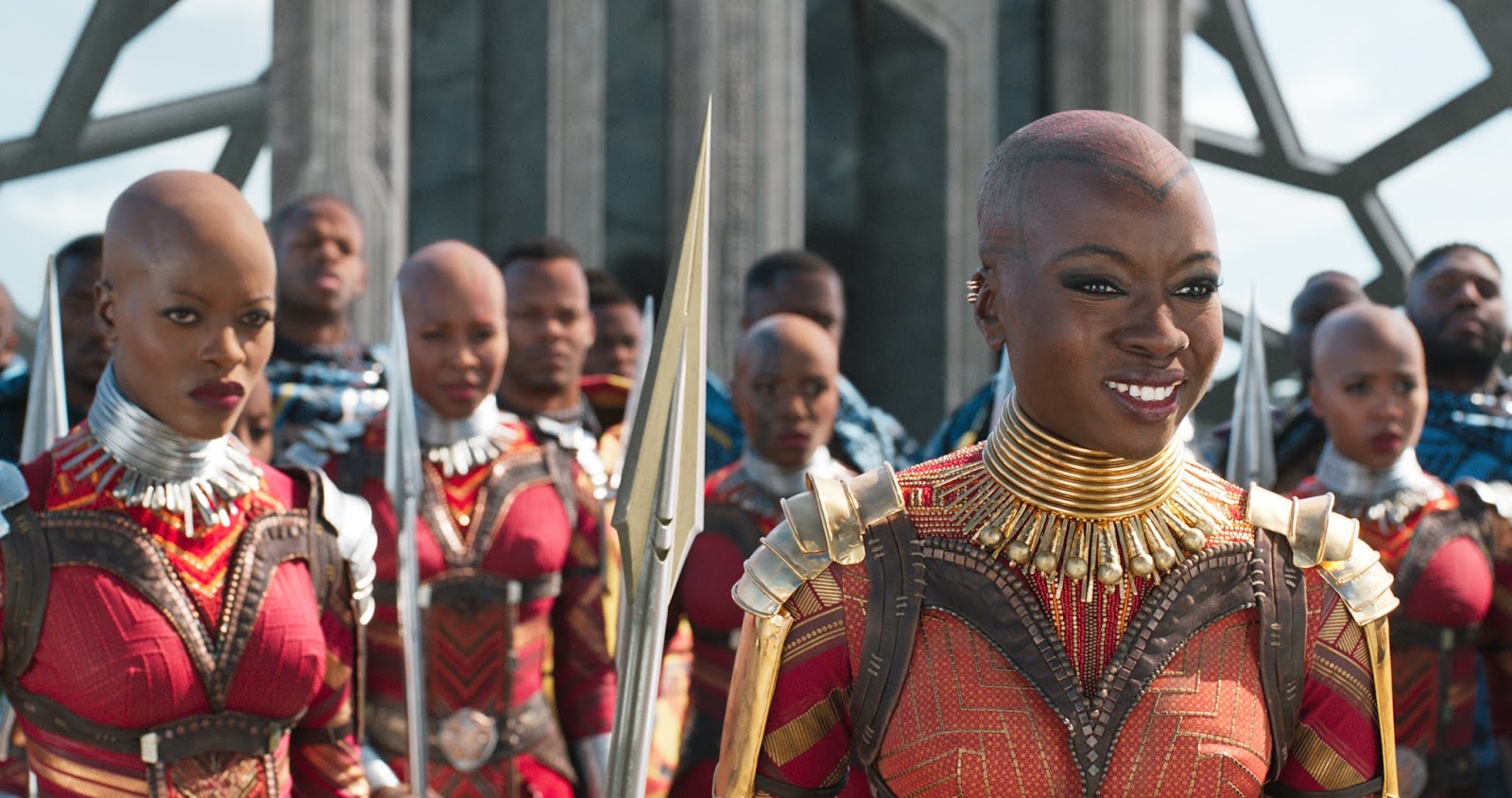
In terms of diversity, Black Panther is notable not only for it's portrayal of non-white culture, but also for it's portrayal of women.  From the Dora Milaje (the all female army of Wakanda) to Shuri, from Nakia (Lupita Nyong'o) to Ramonda (Angela Bassett) these women are strong, smart and fierce, but also independent individuals drawn as separate unique people (rather than just some female bums on seats, filling up the ranks). 
Are you excited and a bit frightened?  That is the correct response.
In thinking about it, there's a load of inclusivity and a good chance that most people can find someone to identify with.  Man? Woman? Disabled? Able bodied? Tattooed? Ink free? Scarred? Unblemished? Bald? Hirsute? Masculine? Feminine? Androgynous? There's someone for everyone.  I have seen some criticism that a potential gay storyline (between Okoye and Ayo) wound up on the cutting room floor, which is reasonable in some ways.  In other ways, sexuality can be found in the subtext if you're looking for it - in the same way it can be found in Top Gun.  And although it is definitely a film representing black culture and black experience, it is not done in a way to make it isolating.  If anything, it feels welcoming and inclusive. 
Take my breath awaaaaaay... 
The concern and scrutiny now turns to Avengers: Infinity War.  The MCU have their own raft of usual writers, directors and producers which now must work with the Black Panther team to produce something that best serves both (or risks undoing all the good feeling that Black Panther has brought to the predominantly white, male MCU).  Black Panther and Wonder Woman have both proved there is a huge market and interest in non-white, and non-male leads and stories.  In the time it's taken you to read this review, Black Panther has probably made another eleventy million pounds (as of 5th March, it's grossed $899.9 million and is the fastest Marvel film to reach the $50 million mark).  No pressure, MCU, but Wakanda forever! 

Additional thoughts, questions and comments:
  • So...all the heart shaped herbs are now gone, we assume?  How does the next Black Panther get their superpowers?
  • Killmonger specifically states that each of the marks on his body represents someone that he's killed.  Is that specific to him, or is that what all those marks mean?  W'kabi has the same marks on his face, but do they represent people he's killed?
  • Is it...a bit like The Lion King?
* Blade doesn't count.  Not in the MCU.  Sorry.

Wednesday, 30 August 2017

The Big Sick

(Warning: contains spoilers for The Big Sick)

It’s difficult to know where to start with real-life stories in films.  Can they be critiqued in the same way as a completely fictional film?  In the case of The Big Sick, it is a real-life story about a real-life event, where the writer and producer is the main character.  So…even if parts don’t make sense, or characters seem odd, that’s how it happened, right?
Image for The Big Sick
The Big Sick is an independent, inter-racial rom-com about the relationship between Kumail (played by Kumail Nanjiani), and Emily (Zoe Kazan), who meet, date and break up.  At the point of their break-up, the eponymous Big Sick appears and Emily winds up in a medically induced coma.  Unsure of whether to go (they have broken up after all) or stay (because he is a decent human being who wants to check if his ex is ok), he winds up meeting Emily’s parents - Beth and Terry - (Ray Romano and Holly Hunter) and the three become close while sharing this complicated, unfamiliar situation.
Other image you get if you Google The Big Sick
Beth and Terry are some of the most understandable and sympathetic characters in the film.  In the absence of being able to do anything useful for their daughter they resort to various fruitless tasks, keen to just fill in the time until she wakes up.  Terry diligently writes down every jargony medical term and medication used ("is that with a 'ph' or with an 'f'?") in an allocated notebook, while Beth ponders whether the hospital is the best one for her daughter ("it's ranked seventh") and tries to out-think the hospital staff. Initially suspicious of Kumail ("she tells us everything"), their relationship together is hesitant and sweet and becomes a different kind of parental as they go to watch Kumail's open-mic comedy performances, where they tackle Islamophobia and hecklers in a way that only parents would.  Through spending time with Emily's parents, Kumail realises how little he knows about his own and begins to rectify that in small ways, like asking which film they met at during their first arranged date.

Running parallel to this story line are two other storyline threads (and they do run parallel because those threads don't really converge).  One is about Kumail’s ongoing pursuit of being a stand-up comedian, playing open mic nights and hoping to get his big break while working for Uber to pay the rent.  The other (significantly more interesting) thread is Kumail’s family dynamic.  Kumail’s parents - Azmat and Sharmeen (Anupam Kher and Zenobia Schroff) are from Pakistan, and have moved to America to give their children more opportunities.  But they have strong ideas about their children maintaining Pakistani traditions - and every Friday night, Kumail's mum invites a girl to "just pop over" to meet him (with a photograph, resume, and ideally a semi decent knowledge of The X Files), in the hope it will lead to an arranged marriage with someone from the same culture ("in Pakistan, we just call it marriage").  Kumail's parents are unaware that he is dating Emily.  Emily is unaware that Kumail's parents are setting up an arranged marriage for him.

The development of Kumail's struggle between his Pakistani and American heritage is an interesting one, and certainly gives The Big Sick a unique selling point.  As a theme, it's been recently played out in Aziz Ansari's Master of None and poses a number of interesting points.  Kumail faces small, potentially racist comments and assumptions throughout the film which he bats away with weary good humour.  Some are well intentioned (Terry trying and failing to connect to Kumail:  "So...9/11...I've always wanted to...talk to someone [like you] about that."), some are more malicious (like the heckler who tells him to go back to ISIS "because of how he looks").  Kumail's parents acknowledge that they wanted their children to grow up in America, but constantly point out in small ways how Pakistan is better ("kulfi is better than icecream").  Kumail is keen to keep up appearances - he doesn't pray, but leads his parents to believe he does.  He doesn't want to break up with Emily, but is happy to let his mother continue to set him up every Friday night without fail.  He rejects their ideals, telling his audience one evening that he knows his career choice is not approved of ("it goes doctor, engineer, lawyer...a thousand other jobs...ISIS, then comedian"), but he still clings on to his heritage, performing in an excruciating one-man show ("do you feel that - that's the weight of Pakistan's history") for no real reason that's ever explained (and I wish had been explored more).  Certainly, a rejection of his parent's culture equals a rejection of them, and although this storyline plays out in the loosest of terms, there is a lot more to be mined here.  (For example, there is an odd moment where they speak Urdu in front of one of the many Pakistani suitors paraded in front of Kumail, not considering that someone from a similar culture and background would probably speak Urdu too, revealing perhaps a small insight into their own views on their American homeland.)  Understandably, if this is one of the "real-life" parts of the film, maybe this is not something that Nanjiani is ready to explore further yet. 
Co-produced by Judd Apatow, there are a lot of Apatow-esque tropes at play here.  Kumail would live happily in most Apatow productions, with his Shaun of the Dead poster, lack of furniture, dishevelled living arrangements, and unparalleled knowledge of B-list horror movies.  He slowly learns to better connect with those around him, and by the end of the film is taking a more active role in his own life (rather than allowing it to passively happen to him).  So far, so Apatow, and I have no qualms about any of those things (other than wishing Kumail would make his bed and wash his sheets).
Not art.  Not a good night's sleep either.
The more unfortunate Apatow trope at play is the portrayal of women, which isn't great.  There are 4 women to speak of - Emily, Beth, Sharmeen and Mary (a friend from stand up).  There are also a small parade of rejected suitors for Kumail.  Mary serves to further Kumail's stand up plot and not much else.  Beth and Sharmeen are good characters who become more interesting when described by their husbands (although definitely the most well defined women of the film).   The strangest thing to me in this whole film (and perhaps why this film hasn't particularly stayed with me) is that I have no real sense of who Emily is.  The film revolves around her, but by the end I know little of her as a girlfriend, a friend, a daughter.  She works as a Domestic Violence Support Worker (a very specific job title which is never mentioned again), and...maybe that's it.  There is little focus on her in hospital, there are no bedside vigils, there are no stories about what Emily is like.  This could be fine - it could be billed as a story about Kumail, Emily's parents, Kumail's parents, those interactions, the clash of two different cultures.  In which case the Big Sick of the title would just be the maguffin that catalysed the plot.  But it's described as a rom-com.  And although there is rom, and com, it's with a very thinly sketched Emily.  Again, maybe it's still too hard to write - it is, after all the real-life Emily and Kumail writing the story.  I do wonder what real-life Emily makes of this production.

Additional thoughts, comments and questions:
  1. The quote on the Shaun of the Dead poster ("an absolute blast") was from zombie-meister George A Romero.
  2. Adeel Akhtar seems to have been singled out for praise in some of the reviews I've read, but I can't actually remember his contribution to the plot.
  3. The moment where Kumail tried to see Emily's apartment through her parents eyes (and edit accordingly) was quite sweet (as he hid a bag of cannabis from sight).
  4. There is a good film in here.  But maybe the rom-com is dead? 

Monday, 7 August 2017

Spider-Man: Homecoming

(Warning: contains spoilers for Spider-Man: Homecoming, and other Marvel films)

There are many things that the world really doesn't need right now, and another Spider-Man reboot is arguably on that list.  This is the 6th Spidey film in 15 years (without counting the cameo in Civil War) and the whole idea was starting to feel more than a little hackneyed.

Is this the poster layout for all blockbuster films now?
Kudos, then, to Marvel for reintroducing us to the webbed wonder in the form of 21-year old Tom Holland (less Holland-y than Tom Holland-er, maybe?), and not restarting the entire backstory again (surely there's only so many times that poor Uncle Ben can be killed off?).  Double kudos for managing to create a film that fits into the Marvel universe as seen thus far, whilst making a film about the teen angst of being at high school, and also adding in a reasonable villain premise and backstory.  Triple kudos for not making that film feel like an absolute grind - 2 hours 15 minutes flew by.

Marvel Cinematic Universe films have form for luring audiences in to superhero films, getting us to like them, and then bogging us down in a mire of politics and tortured conflicts, and in so doing sucking all the joy out of the character that brought us to the film in the first place (see: Thor: The Dark World, Avengers: Age of Ultron, Captain America: Civil War).  The MCU does well when it scales back, which is what it’s done here.

Spiderman: Homecoming picks up Peter Parker where we left off with him in Civil War.  There's been a clash between the various factions of Avengers (nicely referenced at the start of the film by Peter's vlog, and also quickly outlining the relationship between Peter, Happy and Tony Stark).  Peter is left vague instructions to check in with Stark via Happy, "...and y'know...we'll call you".  An excitable Peter misses that this is probably a brush-off, and drops everything he loves in his life just in case he gets a crucial Avengers call, leading to double-life conflicts with his friends (including the scene-stealing Jacob Batalon), his school, his love interest (Laura Harrier) and his Aunt May (Marisa Tomei). On the constant look-out for anything suspicious that gets his Spidey-senses tingling, he happens upon a number of unusual events and, in the absence of being able to get Happy’s attention, sets about trying to save the day himself, with varying consequences. 

The triangle between Peter, Happy and Tony is an interesting one, and it’s clear to audiences that there is a real sense that Peter is not being taken seriously.  I’m a bit confused in this because I’m not sure what else Peter was supposed to do.  He was given his hi-tech costume, and told to be patient, but there was no real sense of progression for him.  Obviously things weren’t going to end well when he found he could disable the training programmes in the suit (and there was a lot of comedic value in the various settings that had been added, as well as Peter’s chats with June, Jennifer Connelly’s Siri-like voice in his suit.  A nice real-world touch, given that Paul Bettany - Connelly’s husband - voices Jarvis in Stark’s own suits).  But what was Peter supposed to do to advance in his training, and how was he meant to graduate to the main programming?  Continuing to be patient (as instructed) would not have helped, and there was no sense that Tony intended to come back at a later stage and help out.  This is somewhat rectified by the ending where Tony offers proper mentoring at the new Stark building in recognition that the “just be patient” advice hadn’t worked for Peter, but given that it could never have worked, I’m not sure what Tony’s actual plan was.  This was subtly symbolised on the two suits Tony offered Peter.  In his first suit, the legs of the spider aren’t attached to its body, essentially rendering the creature useless.  This is rectified in the second version of the suit that Tony offers – the spider’s legs are attached, as he is offered fuller integration with the Avengers group.  I digress.

The high school plot feels well-written, and Peter’s action in his high school life has very real and very important consequences for him (think Mean Girls if Cady was also a superhero).  In fact, Peter’s high school feels real.  An ethnically and racially diverse group of students who have some great teachers (the Decathlon coach, for example) and some jaded ones (the ones who point out that Captain America is “probably a war criminal now or whatever”, but direct the students to watch the schlocky Governmentally produced films anyways).   Peter’s constant attempts to impress Tony and Happy also land well.  It’s the same issue – Peter just wants to be part of the cool gang (in his school world as well as his superhero world).  His Spiderman set pieces (the elevator in the Washington monument, the Staten Island Ferry) also feel in keeping with his Peter Parker persona – of course Spider-Man would think to look for points of strength to shoot webs to.  Peter Parker is the kind of kid who would know that stuff).

Separately from this, Michael Keaton is playing Adrian Toomes, who is making a living as the head of a salvage company clearing up the city (and finding the work to be plentiful after the Avengers have been in town).  Mercilessly driven out of business by a bigger company (contracted in part by Tony Stark), Toomes finds himself out of work and being picked on by the bigger company (in a nice, if depressing, reflection that bullies don’t just go away when you leave school).  He hits back by scavenging whatever alien technology he can find, using it to create his own alter-ego (Vulture) and selling on whatever he can’t use.  In a world where the recession is still felt, Toomes’ anger is understandable and realistic and a far cry from the pantomime versions of villains previously seen in other superhero films.  There is no “wrong” here – Tony Stark is right to want to tidy up the mess that he makes of a city in his Ironman guise, and Toomes is right to want to make a living doing what he believes he was being contracted to do.  Both opinions are morally ambiguous.  That said, did Vulture have a plan beyond “take Tony Stark’s stuff”?  I do wonder what the younger audience members made of this particular plotline. 
Michael Keaton = giant bird.  Check.
The bringing together of these two strands (the Peter Parker/Spider-Man and Adrian Toomes/Vulture strands) gets a little wobbly.  While the reveal of these two characters to each other is very well done, the showdown between them circles back to the ongoing downfall of superhero finales: no consequences unless the script says so.  Meaning that all superheroes can get beaten stupid with no real impact or effect.  And this showdown was riven with so much CGI that a lot of tension was stripped away.  A plane falls out of the sky (and it took me a moment to realise that was what had actually happened) and the biggest consequence seemed to be that Tony Stark’s stuff might have been damaged?  There was no peril, there was no danger, because at no point did I believe either Parker or Toomes would come to any harm.  That’s a sad result for what must be a multi-million dollar set-piece that will have taken hours of work from a very skilled cast and crew.    

There’s a further sinister note that isn’t commented upon – all characters at (presumably) all times are under surveillance.  From drones, from phones, from CCTV, from gadgetty doodahs in Stark suits.  Nothing is private.  This seems to be generally accepted, and perhaps in the real-world too.  There is an ethical question that has yet to be asked in the MCU – should superheroes be able to track anyone at any time without their permission, or is this just a plot device that I’m overthinking?

But these are quibbles in an otherwise entirely enjoyable romp through one part of the MCU.  Holland’s take on Spider-Man is endearing and enthusiastic and entirely likeable.  In a household where spiders are routinely trapped under cups and flung out the nearest window, I look forward to seeing more of watching this guy do whatever a spider can. 
Legitimate question
Additional thoughts, comments, questions:

1.  I particularly enjoyed the new BBFC warning: “contains concealed bad language”.  That’s right up there with “mild peril”. 

2.  Whoever thought we’d be rooting for Iron Man and Aunt May to get together? 

3.  How come high schoolers can always fit so many people in their houses at illicit parent-free parties? 

Sunday, 6 August 2017

Baby Driver

(Warning: contains spoilers for Baby Driver)

In The Mysterious Cities of Gold (an 80s cartoon that I am wary of revisiting in case I discover it was complete tosh, despite having one of the best theme tunes ever), main characters Estaban and Zia both possess interlocking parts of a gold medallion.  When those two parts come together, it unlocks the eponymous Cities of Gold, filled with wonders and riches.

Similar things happen when Edgar Wright and Simon Pegg work together.  There is a weird alchemy and synchronicity between the two - the same knowledge, the same vision - and gold is spun.  That gold looks like Spaced and The Cornetto trilogy (Shaun of the Dead, Hot Fuzz, World's End).  When separated, audiences are left with nuggets of the purest green...(Paul, Scott Pilgrim Vs the World, Absolutely Anything [where Simon Pegg is the lead character])

But both Wright and Pegg have generated enough good will between them that audiences will still risk the price of a cinema ticket to see if the next project will be green or gold.  This summer we test Baby Driver.

Conceived by Wright in 1994, the film is the story of Baby (Ansel Elgort) who works as the getaway driver for a varying group of bank robbers led by kingpin Doc (Kevin Spacey) in order to pay off a debt.  Suffering with tinnitus, he relies on music to soundtrack his life, dictate his mood, and tune out some of the underlying auditory condition.  When not driving or sitting in corners, he looks after his deaf foster father (CJ Jones), falls in love with Debora (Lily James) and occasionally thinks about his deceased biological mum (Sky Ferreira).  Baby wants out of the heist life, Doc dangles the carrot of "just one more job".  Baby discovers that business (life with Doc) and pleasure (life with Debora) don't mix.  Hijinks ensue.

Straight off the mark, this looks and sounds like an Edgar Wright film.  Catchy soundtrack over a number of sharply shot and executed set pieces.  The opening 6 minutes can be found here, and gives a pretty accurate flavour of the mood of the film.  Personally, I preferred the following sequence where Baby is sent out to get the coffee and everything is perfectly synchronised to the music he is listening to and the mood he is in (with a nice call back later in the film when things are not going right for him, and nothing seems to "work").  Although it's set in America, and all the characters appear to be American, it feels very "British".

Some characters and relationships are very well realised - I very quickly liked the relationship between Baby and Joseph, which simultaneously felt like a relationship of peers, as well having a parent/child relationship.  The short hand of their routines, and the fluidity of their sign language to each other was another great visual element of things working well in Baby's life.  I would have happily watched a film solely about these two.
Best relationship in the film
But other characters felt a lot flatter.  Bats (Jamie Foxx) and Griff (John Bernthal) felt that they had no existence outside of their scenes.  Buddy (Jon Hamm) and Darling (Eiza Gonzalez) - while enjoyable - felt like a retread of Pumpkin and Honey Bunny in Pulp Fiction.  I find it difficult to comment objectively on Spacey's performances - I can't see past him just being Kevin Spacey.  In particular, this felt like his Frank Underwood - vaguely genial front, deadpan, not to be messed with.  that said, Spacey does seem to have his diversity quotient in order for all his henchmen.  There's a wide range of BAME roles at play here.  As for Debora, I could understand why she and Baby would fancy each other, but I wasn't convinced that she would give up everything to be with him.  Yes, it was because there was nothing else going on in her life, but that in itself just adds to the argument that she's a fairly 2-dimensional character.  Everything we learn about her, we learn from other characters telling us about her.

The film itself lasts about 20 minutes too long, and becomes somewhat cartoony in its ending.  I struggle with films where the boundaries and consequences are unclear, and in the final showdown between Baby and Buddy, Buddy goes from being a mere mortal to being unkillable (after being beaten up, AND hit by a car AND set on fire).  And though I appreciated that there were consequences to his actions (Baby goes to prison after breaking the law, BUT his positive actions are taken into consideration), the coda of Baby and Debora's reunion felt a little stuck on.
Why won't you die?
Where this film should be championed is in its challenging of assumptions of disability.  The majority of characters - on their first meeting of Baby - make assumptions about him.  That he is not listening or that he has some form of disability (leading to the "is he retarded?" exchange between Griff and Doc).  Pleasingly, Doc never feels the need to explain Baby to anyone but does challenge their assumptions ("Retarded means slow.  Was he slow?" queries Doc after an all-out adrenalin rush of a car chase).  For the most part, Baby is given opportunity to explain himself at his own pace to whomever he chooses.  Baby proves time and again that not saying much does not mean there's a problem.

As mentioned previously, one of the strongest relationships is between Baby and Joseph.  Joseph is deaf and the two communicate by sign language (can anyone else think of any other examples of a non-white actor with a disability in a mainstream film?).  The sign language itself is part of the aesthetic of the film - it's not just there to be functional.  Wright's direction of that sign language speaks (poor use of wording there) volumes about the relationship between Joseph and Baby, adds wit, adds warmth, adds familiarity.  A massive well done on that front.  Now just Wright (ha!) some better women.

Additional thoughts, comments and questions.

1.  Kevin Spacey as Doc enters the pantheon of actors over 50 who unexpectedly take on action roles (see also: Liam Neeson - Taken, Colin Firth - Kingsman).

2.  Ansel Elgort learned sign language for his role in this film.

3.  Baby Driver is not a good title for a film.

4.  Here's the theme tune to the Mysterious Cities of Gold.

Friday, 24 March 2017

Moonlight

(warning: contains spoilers for Moonlight)

So, the thing about La La Land is that...Wait, there's been a mistake. 

Moonlight is the film I'm reviewing (laaaaame joke, but it's right there).

So, now we're out of Oscar season, we know that Moonlight came away with a very respectable haul of awards, winning Best Picture, Best Adapted Screenplay and Best Supporting Actor for Mahershala Ali (a name that is particularly pleasing to say).  As such, it has created a lot of "firsts".  For example: it is the first film with an all-black cast and the first LGBT film to win the Academy Award for Best
Picture.  Joi McMillon (one of the editors) became the first black woman to be nominated for an editing Oscar.  Mahershala Ali is the first Muslim to win an acting Oscar (and is one of an embarrassingly small group of 17 black actors who have won an acting Oscar).  So we know that it is a history making film.  Honest Trailers went as far as renaming it "All the Oscar Things" after describing it thus:

"...a poetic unfolding of a life, beautifully directed by Barry Jenkins as this young (tick), black (tick), gay (tick) man struggles to escape from poverty (tick) and drug addiction (tick).  Told across three decades (tick), based on the life story of it's author (tick), so yeah I'd say it's nominated for an Oscar."
Definitely not La La Land
That's a good description.  Inspired by the unpublished theatre project "In Moonlight Black Boys Look Blue" (Tarell Alvin McCraney), the film is split into three parts each of which is named after the different identities that the central character is known by ("Little", "Chiron" and "Black") in his childhood, adolescence and adulthood respectively.  Those acts break very cleanly into setup, confrontation and resolution.  There is no driving plot narrative, each part examines the life of the protagonist - where he is, who he's with, what he's doing.  The only two other characters that recur in all three parts are Paula (Chiron's mother, a care worker whose addiction to crack and subsequent decline is charted as the film progresses.  She is played by an almost unrecognisable Naomie Harris) and Kevin (Chiron's childhood friend, and the subject of his first sexual experience).

In terms of awards, for me it's not the best film but it is an important one.  On the back of the #Oscarssowhite furore of the past few years, here is a film that speaks about what it is to be a) black and b) gay, and be proud of both.  Is there a comparable film - if there is, I don't know it.  A good film should enable me to experience, understand and empathise with characters who have a different experience than my own.  To that end, this film succeeds by miles.  Additionally, the juxtapositions are stark, but pass by almost without being commented upon.  Black (as he is at the end of the film) outwardly looks fierce, with unsmiling gold teeth, but is the most vulnerable and brittle character of the film.  There are virtually no older role models (particularly male role models).  The closest we have is Juan (Ali) who is a mess of contrasts himself - a tall, imposing man who is a drug dealer but who befriends the young Little and confounds expectations by teaching him how to swim, making sure he is fed, offering his own home with its clean (and always available) spare bed and providing this foundation to teenage Chiron's sexuality:

Chiron: "What's a faggot?"
Juan: "A faggot is a word used to make gay people feel bad."
Chiron: "Am I a faggot?"
Juan: "You might be gay but don't let anyone ever call you a faggot."

It is positively cheering that Juan is the most "masculine" character, and the absolute model of gay acceptance.  He features heavily in the life of Little, and then symbolically in the life of Chiron (in the house that Chiron visits) and Black (represented by the little gold crown on the dashboard of his car).

Spoilers: Juan does not just drop Little in the sea.
I would totally have done that.
And that's why no one makes films about me.
I doubt it is accidental that none of these characters "succeed" in a conventional sense.  By the end, most have been involved in drugs, prison, gangs and fights.  Their jobs are low income, or downright illegal.  Everyone in Black's life is under some kind of state surveillance by the end.  But none of that matters because they are all more than their circumstances.

If I'm honest, I wasn't blown away by this film when I first saw it.  I watched in a warm cinema on a Monday evening after work.  I was half asleep, and this film is not full of riveting action.  But the more I write about it in this review, the more sure I am that I need to see it again.  And so do you.

Important life lesson: always love a man who can cook.
Additional thoughts, comments, questions:

1.  This is not a particularly female friendly film.  The two women Paula (Naomie Harris) and Teresa (Janelle Monae) are thinly written at best.  But even they provide an interesting contrast to each other as Chiron's biological mother (who neglects him) vs his "adoptive" mother who has no children, but is a better parent.

2.  Parenting itself is a noteworthy theme of the film.  When Juan calls Paula out for being a neglectful, drug addicted mother who cannot take care of her child, she rightly points out that he is the person selling her drugs so is contributing and participating in the neglect of Chiron.

3.  This film looks beautiful.  I want to go to Miami and eat all the food.