Showing posts with label LGBT. Show all posts

Tuesday, 6 March 2018

Black Panther

(Warning: contains spoilers for Black Panther, Wonder Woman and general MCU)

Something new from the MCU - a film where the main protagonist isn't a white man.  Gadzooks, what is this brave new world?
Black Panther
Black Panther is set in Wakanda, a nation composed of 5 tribes in Africa built on meteorite called Vibranium.  With Vibranium, they advance in terms of technology, but disguise themselves as a Third World country in order to protect what they have.  King T'Chaka's (John Kani) death leads to the throne being taken by his son T'Challa (Chadwick Boseman).  He is challenged by Killmonger (Michael B. Jordan), who provides a legitimate claim to the throne and gathers the support of a number of T'Chaka's key allies.  Power struggles ensue.
  
Black Panther, by its very existence, is going to have similar scrutiny levelled at it as Wonder Woman did last year.  Where Wonder Woman was the first non-male in a lead role (in either DC or MCU), Black Panther is the first* superhero film in the MCU to feature a black lead and predominantly black cast (apart from the Tolkien white guys Martin Freeman and Andy Serkis, and Stan Lee who turns up in a film as a stamp of MCU authenticity).  It's been a long time coming.  Wesley Snipes has been talking about trying to make a Black Panther movie since 1992.  Indeed, in 2005, the CEO of Marvel announced that Black Panther was one of ten Marvel films to be developed by the studio.  Over the past 12 years, it would seem that the film has been offered to various writers and directors (including John Singleton, Mark Bailey and Ava DuVernay) who have played with the idea and passed on it, perhaps not relishing the idea that all cultural expectation would weigh heavily on whoever made this film.

The final film was written by Joe Robert Cole (The People Vs OJ Simpson) and co-written and directed by Ryan Coogler (Creed), who accepted on the proviso that he could bring his own collaborators from different previous projects, rather than relying on the "in-house" Marvel creative team.

The result is glorious.  Having seen this film once, I already feel as though these are characters I have known for longer.  Each is well developed and realised, so that the decisions they have to make have weight and consequence.  Each has a distinct style and tone, which means that already the film has been embraced by fans and cosplayers (imperative in the geek culture).  Letitia Wright (Shuri) has been particularly singled out for praise as a teenage version of Bond's Q, but praise has generally been effusive for all the cast.

As with Spiderman: Homecoming before it, (and with a number of films already released in 2018), there was no real thing as the "good guys" and the "bad guys".  Both sides had their strengths and weaknesses, and both sides were understandable, which made tensions between lovers W'kabi (Daniel Kaluuya) and Okoye (Danai Gurira), or friends W'kabi and T'Challa more resonant.
A thing that I was particularly pleased about is that although the final battle did involve punching each other stupid, there were distinct boundaries at play so there was a real understanding of how this battle could be won and lost (Shuri used the underground trains to disrupt the Vibranium in the suits, so that T'Challa and Killmonger would be both be vulnerable when the trains were going past and could be harmed).  This is at real odds with most other superhero films where the bad guy dies for no other reason than because the script says so.

In terms of diversity, Black Panther is notable not only for it's portrayal of non-white culture, but also for it's portrayal of women.  From the Dora Milaje (the all female army of Wakanda) to Shuri, from Nakia (Lupita Nyong'o) to Ramonda (Angela Bassett) these women are strong, smart and fierce, but also independent individuals drawn as separate unique people (rather than just some female bums on seats, filling up the ranks). 
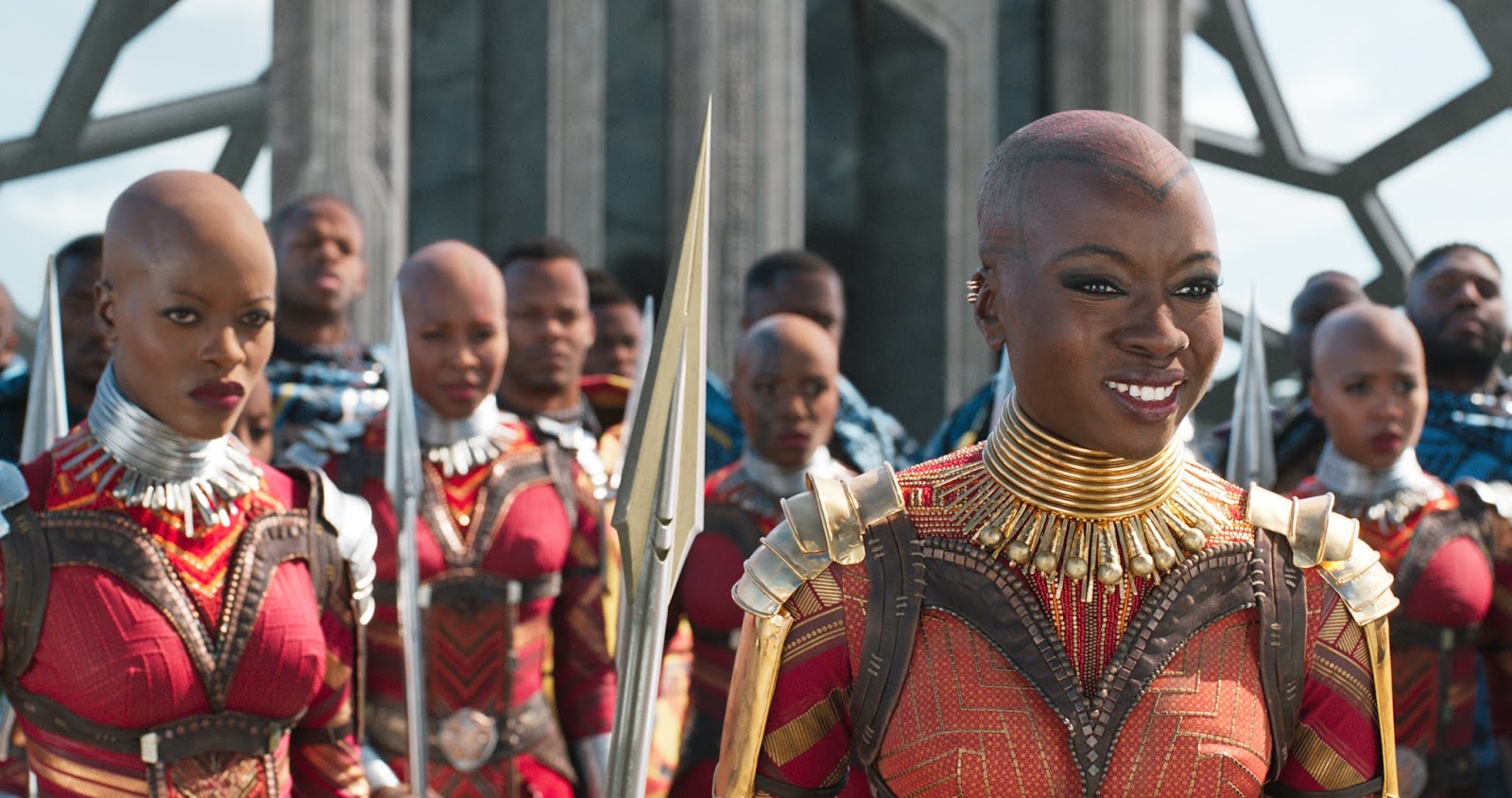
Are you excited and a bit frightened?  That is the correct response.
In thinking about it, there's a load of inclusivity and a good chance that most people can find someone to identify with.  Man? Woman? Disabled? Able bodied? Tattooed? Ink free? Scarred? Unblemished? Bald? Hirsute? Masculine? Feminine? Androgynous? There's someone for everyone.  I have seen some criticism that a potential gay storyline (between Okoye and Ayo) wound up on the cutting room floor, which is reasonable in some ways.  In other ways, sexuality can be found in the subtext if you're looking for it - in the same way it can be found in Top Gun.  And although it is definitely a film representing black culture and black experience, it is not done in a way to make it isolating.  If anything, it feels welcoming and inclusive. 
Take my breath awaaaaaay... 
The concern and scrutiny now turns to Avengers: Infinity War.  The MCU have their own raft of usual writers, directors and producers which now must work with the Black Panther team to produce something that best serves both (or risks undoing all the good feeling that Black Panther has brought to the predominantly white, male MCU).  Black Panther and Wonder Woman have both proved there is a huge market and interest in non-white, and non-male leads and stories.  In the time it's taken you to read this review, Black Panther has probably made another eleventy million pounds (as of 5th March, it's grossed $899.9 million and is the fastest Marvel film to reach the $50 million mark).  No pressure, MCU, but Wakanda forever! 

Additional thoughts, questions and comments:
  • So...all the heart shaped herbs are now gone, we assume?  How does the next Black Panther get their superpowers?
  • Killmonger specifically states that each of the marks on his body represents someone that he's killed.  Is that specific to him, or is that what all those marks mean?  W'kabi has the same marks on his face, but do they represent people he's killed?
  • Is it...a bit like The Lion King?
* Blade doesn't count.  Not in the MCU.  Sorry.

Sunday, 18 February 2018

The Shape of Water

(Warning: contains spoilers for The Shape of Water)

It's getting closer to the Oscars and one of the big contenders is The Shape of Water, leading with 13 nominations.  Four of those are for "The Big Five" (Best Actor, Actress, Picture, Director and Screenplay - The Shape of Water does not have a nomination for Best Actor).  As a result of this, and as a result of its frankly beautiful trailer, I have been keen to see this for some time.
The Life Aquatic...?
Admittedly, the premise - woman falls in love with sea creature - is not typical movie fare, and certainly not typical Oscar movie fare.  So what makes this different?

Good question.  This is a Guillermo del Toro film, so from the outset it can be assumed that this is a fairy tale featuring monsters (as per Pan's Labyrinth).  As per all fairy tales about monsters, it can also safely be assumed that the monster is probably not the thing that looks like a monster.  It's probably closer to the thing that looks like us.  Or, if it's a film with Michael Shannon in it, it's probably Michael Shannon.  Del Toro has credited some of the inspiration for this film from Creature from the Black Lagoon, but there's also touches of Splash, Amelie, and Buster Keaton/Charlie Chaplin throughout.

The film is told by Giles (Richard Jenkins), a struggling, gay, alcoholic illustrator.  It is about his next door neighbour, Elisa Esposito (Sally Hawkins) - a mute janitor who cleans at a government facility in Baltimore.  One day, a creature (played by Doug Jones) is brought to the facility.  Over time, Elisa develops a relationship with the creature who is being mistreated by the programme director (Michael Shannon).  She begins to plan to help the creature escape.  Aquatic adventures ensue.

The film itself is beautiful.  Set at some point in the early 1960s, it opens with a completely underwater sequence which positions Elisa as a fairytale princess living above a theatre, before draining all the water completely and setting about efficiently sketching Elisa's life - masturbation, eggs, sandwiches, musicals with Giles and working with Zelda (Octavia Spencer).  The colour palette morphs from greens and blues (and teal) to splashes of red when Elisa begins her relationship with the Amphibian Man (that's what's he's called in the credits, so I'll go with that), a fact that was completely lost on my colour-blind husband, who unfortunately perceived the film in mainly sepia tones.  The Amphibian Man himself is quick to light up like a Christmas tree (literally) as soon as he is shown affection.  They literally bring more colour into each others lives.
In direct contrast, it's also worth mentioning the large dollop of body horror in the film too - from Strickland's rotting fingers, to Hoffstetler (Michael Stuhlbarg) having a hole shot in his face, there's a lot to be grossed out by.  There are bits that are definitely not for the squeamish.
Not Abe Sapien.  Definitely not Abe Sapien.
I have read a couple of reviews which have described the relationship between Elisa and the Amphibian Man as that of two outsiders who find love.  I have mixed feelings about this.  In some ways, Elisa can be seen as an outsider because of her muteness.  Similarly, Zelda is an outsider because of her colour, Giles is an outsider because of his sexuality, Hoffstetler is an outsider because he is not American (and the Amphibian Man is an outsider because of not being human).  But Elisa doesn't seem to be lacking anything - she seems content with her life, her job and her friends, and there doesn't seem to be something else that she aspires to or desires.  Nor is there anyone who suggests she is anything less than fine - the closest we come to that is the sinisterly sexual overtones of Strickland (Shannon) who is odious to everyone, not just Elisa.  A different reading of the film is that Elisa and the Amphibian Man are two similar creatures who find each other and find love (the suggestion is made that Elisa is an Amphibian Woman - she was found near water with scars on her neck which may have always been gills).  Conversely, Zelda, Giles and Hoffstetler all think they have found equal partners, but they are all disappointed (and not just because the pie guys pies looked vile).
Mmm...pie.
If I were to make a small criticism, it would be that I didn't understand what the bad guys actually wanted.  If Strickland (or the various other governmental agencies) were experimenting on the Amphibian Man to better understand what he was, that would make more sense.  But Strickland seemed to just be electrocuting him for no discernible reason.  I could also have done with less of the double-crossing-spy-agents storyline.  It didn't particularly add anything to the storyline, and since it's Giles' story to tell, I'm not sure how he would have discerned all that information.  I'm also a little disconcerted that no one bats an eyelid when Elisa starts having a relationship with a sea creature (but it's a del Toro film, so maybe that's fine?).

When the Oscars roll around, I think it's a strong contender for Best Picture but I don't think it will win (fantasy rarely does).  Hawkins may win against Frances McDormand for Best Actress but it's a tough call.  I think Guillermo del Toro may get Best Director.  Alexandre Desplat may win for Best Score.  But I think this may be one of the films that leads in terms of nominations, but walks away with little. 

If that's the case, I'm sure Zelda will have something to say about that...

Additional thoughts, questions, comments:

  • Is Elisa selectively mute?  She seems to speak, but that's as part of a fantasy moment - was any of it real?  Is Strickland's assessment that her voicebox has been cut an accurate one?
  • Alexandre Desplat created a beautiful score for this film - it sounded a lot like the theme from Up to me, with elements of The King's Speech (another Desplat score).
  • Giles' cats seem remarkably forgiving of a creature that eats the head off one of their friends.
  • Do green and red represent something?  Giles is asked to paint green jello instead of red; Strickland's candy is green; the pie guy's pie is green.  I should watch this film again...

Sunday, 10 September 2017

The Limehouse Golem

(Warning: contains spoilers for The Limehouse Golem)

In pre-Ripper London, Inspector John Kildare (Bill Nighy) is tasked with the dubious fortune of investigating and uncovering the identity of the eponymous Limehouse Golem, a serial killer with no apparent modus operandi.  Kildare knows that his appointment is tainted - Scotland Yard have come to a dead end, and - not wanting to risk the reputation of their best people - Kildare is appointed, with Sergeant Flood (Daniel Mays).
There are four potential suspects - Karl Marx (Henry Goodman), George Gissing (Morgan Watkins), Dan Leno (Douglas Booth) and John Cree (Sam Reid), but Cree is found dead - killed on the same night as the last Golem murder.  His wife - music hall star Lizzie Cree (Olivia Cooke) - is believed to have poisoned him.  Kildare finds links between Cree and the Golem, theorises that John Cree has in fact killed himself to assuage his guilt of being a murderer, and must solve both cases before Lizzie's trial ends and she is sentenced to hang.  The game is afoot!
More posters with Bill Nighy, please.
Based on the 1994 Peter Ackroyd novel (Dan Leno and the Limehouse Golem), this film has been adapted for the screen by Jane Goldman (Kick-Ass, Stardust, Kingsman, The Woman In Black).  A lot of Goldman's past works have been dark, but usually there is humour to alleviate it (although in this case, colour is found in the music hall scenes) .  Similarly, Bill Nighy's previous works would suggest that there would be some levity in proceedings, but he doesn't crack a smile.  It's not that kind of film.
That said, it's a bit difficult to describe what kind of film this is - it's part whodunnit, a bit horror, some period drama with a dollop of Penny Dreadful noir, and fright-lite (not dissimilar to The Woman in Black, come to think of it).

There's a lot to unpack from this two hour duration, and my main criticism is that there's not a lot of time and space to let the characters, their stories, and the themes breathe and develop.  In that two hours, there's multiple points at which you could stop the story and just explore the avenue that we find ourselves at the junction of (feminism, LGBT representation, poverty, real-life vs role play, trial by public, media intrusion to name a few).  But the carriage doesn't stop, and instead the audience hurtles on to solve its mystery.  I wonder if this might have made for a better television show (it didn't do The Night Manager any harm) - it feels made for a Sunday night.

I enjoyed the story-telling a great deal - told in flashback from the end to the beginning and back again, the pace and momentum build steadily to a slightly hysterical conclusion before slowing down again to a more leisurely pace.  The ending is somewhat Se7en-esque in its conclusion, though less memorable.
Not Bill Nighy at the end of this film.
The casting is great.  I believe this is Bill Nighy's first time leading in a film (replacing Alan Rickman following his death in 2016 - the film itself is dedicated to Rickman), and he holds proceedings together well.  He conveys much in a glance or a twitch which contrasts nicely, because there is a lot of info-dumping by other characters throughout.  Daniel Mays is a great sidekick and his subtle coming out scene with Nighy was beautifully done (believing Kildare to be the laughing stock of Scotland Yard because of his sexual orientation, he chooses a quiet moment to say "I'm...on your side, sir").  I would happily watch a lot more of the adventures of Kildare and Flood.  On the civilian side of proceedings, Olivia Cooke was great as Lizzie Cree - victim, survivor, darling.  There were a lot of facets to Lizzie Cree, and Cooke made each of them believable and sympathetic.  The supporting cast was good, though I'm not sure of the significance of three real-life personalities (Gissing, Marx and Leno) as murder suspects.  It is worth singling Douglas Booth's Dan Leno out - he stole every scene he was in, I don't think I've seen him in anything else before, and I was convinced for a while that he was Russell Brand.
Rickman's Limehouse Golem would have been very different.
The murderer would have been revealed to a much more sardonic Kildare.
The feminist theme in the film is particularly noteworthy.  The main male characters - for self-serving, or well-meaning reasons - all attempt to save the women.  None of whom are damsels in distress, and none of whom want saving (nor need help).  The term "white knight" is bandied around a fair bit.  Whether or not it can be deemed a "feminist film" is a subject for later debate.  I think this film may achieve cult status over the coming years - there's a lot to unpick. 

One worth watching, though maybe wait for it to leave the cinema.

Additional thoughts, comments and questions:
1.  Juan Carlos Medina's London is mainly filmed in West Yorkshire - I didn't notice.  The next time I watch this will be to see if there's anywhere I recognise.

2.  I wonder how different Love, Actually would be if Rickman and Nighy swapped roles.

3.  Warning:  there is a lot of blood.  And some ocular trauma.

4.  Lizzie Cree has the biggest prison cell, possibly ever.

Friday, 24 March 2017

Moonlight

(warning: contains spoilers for Moonlight)

So, the thing about La La Land is that...Wait, there's been a mistake. 

Moonlight is the film I'm reviewing (laaaaame joke, but it's right there).

So, now we're out of Oscar season, we know that Moonlight came away with a very respectable haul of awards, winning Best Picture, Best Adapted Screenplay and Best Supporting Actor for Mahershala Ali (a name that is particularly pleasing to say).  As such, it has created a lot of "firsts".  For example: it is the first film with an all-black cast and the first LGBT film to win the Academy Award for Best
Picture.  Joi McMillon (one of the editors) became the first black woman to be nominated for an editing Oscar.  Mahershala Ali is the first Muslim to win an acting Oscar (and is one of an embarrassingly small group of 17 black actors who have won an acting Oscar).  So we know that it is a history making film.  Honest Trailers went as far as renaming it "All the Oscar Things" after describing it thus:

"...a poetic unfolding of a life, beautifully directed by Barry Jenkins as this young (tick), black (tick), gay (tick) man struggles to escape from poverty (tick) and drug addiction (tick).  Told across three decades (tick), based on the life story of it's author (tick), so yeah I'd say it's nominated for an Oscar."
Definitely not La La Land
That's a good description.  Inspired by the unpublished theatre project "In Moonlight Black Boys Look Blue" (Tarell Alvin McCraney), the film is split into three parts each of which is named after the different identities that the central character is known by ("Little", "Chiron" and "Black") in his childhood, adolescence and adulthood respectively.  Those acts break very cleanly into setup, confrontation and resolution.  There is no driving plot narrative, each part examines the life of the protagonist - where he is, who he's with, what he's doing.  The only two other characters that recur in all three parts are Paula (Chiron's mother, a care worker whose addiction to crack and subsequent decline is charted as the film progresses.  She is played by an almost unrecognisable Naomie Harris) and Kevin (Chiron's childhood friend, and the subject of his first sexual experience).

In terms of awards, for me it's not the best film but it is an important one.  On the back of the #Oscarssowhite furore of the past few years, here is a film that speaks about what it is to be a) black and b) gay, and be proud of both.  Is there a comparable film - if there is, I don't know it.  A good film should enable me to experience, understand and empathise with characters who have a different experience than my own.  To that end, this film succeeds by miles.  Additionally, the juxtapositions are stark, but pass by almost without being commented upon.  Black (as he is at the end of the film) outwardly looks fierce, with unsmiling gold teeth, but is the most vulnerable and brittle character of the film.  There are virtually no older role models (particularly male role models).  The closest we have is Juan (Ali) who is a mess of contrasts himself - a tall, imposing man who is a drug dealer but who befriends the young Little and confounds expectations by teaching him how to swim, making sure he is fed, offering his own home with its clean (and always available) spare bed and providing this foundation to teenage Chiron's sexuality:

Chiron: "What's a faggot?"
Juan: "A faggot is a word used to make gay people feel bad."
Chiron: "Am I a faggot?"
Juan: "You might be gay but don't let anyone ever call you a faggot."

It is positively cheering that Juan is the most "masculine" character, and the absolute model of gay acceptance.  He features heavily in the life of Little, and then symbolically in the life of Chiron (in the house that Chiron visits) and Black (represented by the little gold crown on the dashboard of his car).

Spoilers: Juan does not just drop Little in the sea.
I would totally have done that.
And that's why no one makes films about me.
I doubt it is accidental that none of these characters "succeed" in a conventional sense.  By the end, most have been involved in drugs, prison, gangs and fights.  Their jobs are low income, or downright illegal.  Everyone in Black's life is under some kind of state surveillance by the end.  But none of that matters because they are all more than their circumstances.

If I'm honest, I wasn't blown away by this film when I first saw it.  I watched in a warm cinema on a Monday evening after work.  I was half asleep, and this film is not full of riveting action.  But the more I write about it in this review, the more sure I am that I need to see it again.  And so do you.

Important life lesson: always love a man who can cook.
Additional thoughts, comments, questions:

1.  This is not a particularly female friendly film.  The two women Paula (Naomie Harris) and Teresa (Janelle Monae) are thinly written at best.  But even they provide an interesting contrast to each other as Chiron's biological mother (who neglects him) vs his "adoptive" mother who has no children, but is a better parent.

2.  Parenting itself is a noteworthy theme of the film.  When Juan calls Paula out for being a neglectful, drug addicted mother who cannot take care of her child, she rightly points out that he is the person selling her drugs so is contributing and participating in the neglect of Chiron.

3.  This film looks beautiful.  I want to go to Miami and eat all the food.