Sunday, 24 September 2017

Kingsman 2: The Golden Circle

(Warning - Contains spoilers for Kingsman 2: The Golden Circle.  Also, contains ranting)

I really liked Kingsman: Secret Service.  It was the surprise hit of 2014, cunningly hidden amongst the post-Oscars dross.  So when the trailer for Kingsman 2 was released I sent it to my friends, and talked about how I was looking forward to seeing it.

I saw it yesterday.  It has a lot to recommend it.  It's funny, and surprisingly moving in places.  But I don't care.  And I don't care for the following reason: the Glastonbury set-piece.

Let me explain what happens in that scene.  Eggsy (Taron Egerton) and Whiskey (Pedro Pascal) are tracking ex-Kingsman recruit, Charlie (Edward Holcroft).  They believe he is up to no good (which is fair enough - he is up to no good).   They decide to follow him by using a tracking device on his girlfriend, Clara (Poppy Delevingne).  The tracking device will give them full audio-visual access to Charlie.  Now, this in itself involves a suspension of disbelief - unless Charlie takes Clara to all his bad-guy meetings, it seems unlikely that they'll get the information that they want, but ok.  I'll buy it.

The problem is this: the tracker has to be implanted "within Clara's mucus membranes" for it to wind up where they need it.  Which means that they need to insert it into her vagina.

Let's leave aside the logic that says that a tracking device inside a person will give everyone else full audio-visual access to plot.

The following scenes run thus: Eggsy is a little grossed out by his potential assignment.  Eggsy and Whiskey compete with each other to work out which of them will complete this task.  Eggsy "wins", and winds up in Clara's bed getting ready to do the deed.  He has a crisis of conscience ("Hurrah", I thought, "they're not going to go ahead with this genuinely awful plotline") and makes an escape.  Except the issue, as Eggsy sees it, is not that what he is about to do will make him an actual sex offender, but that his girlfriend may be annoyed that he is getting up to sexual shenanigans with another woman.  She is.  He proceeds anyways.

So, what the audience then sees is a protracted shot of Clara in her lingerie, while a fully clothed Eggsy reaches into her knickers to finger a tracker into her.  Then he bids a hasty retreat.

I went online after the film to work out what the explanation was for that scene.  The closest I have found is an interview with Taron Egerton saying:  “It’s what Matthew [Vaughn] does, it’s his signature thing. He likes to do something that shocks. In Kick-Ass it was Chloe Grace Moretz saying the C-word, in Kingsman 1 it was the bum shot of the Swedish princess, and in this one it’s the thing. And, you know, it’s not to everyone’s tastes, but it certainly gets people talking. All it is is explicitly showing what Bond alludes to and says in a double entendre kind of way.”

In case you're not entirely sure what the issue is, here are some things for you to mull over:
  1. Putting a foreign object into someone's body without their consent is assault.  When you put something into a woman's vagina, that is sexual assault by penetration.  It comes with a maximum sentence of life imprisonment.
  2. Clara believed that Eggsy was interested in her.  Eggsy acted as if he was interested in Clara.  Eggsy was not interested in Clara as another other than a means to an end.  That end was work-related and no consideration was given to Clara. 
  3. Clara consented to sex.  She brought Eggsy back to her bed for sex.  She did not consent for him to put something inside her.  So although there was an expectation of sexual activity, it wasn't that.  If you are under any illusion otherwise, consider the following scenario: if Clara had found out what Eggsy had done, do you think she'd be alright with it?  Answer: no.
  4. Eggsy is portrayed throughout this film as honourable.  He is "the good guy".  This is not an honourable action.
  5. There is no further reference to this event.  No come-uppance.  No issue with what has happened.  No one even queries it. 
  6. Matthew Vaughn does like to shock.  Fine.  But the two examples given in the quote above are not on par with this.  Hit-Girl chooses to swear in Kick-Ass.  Princess Tilde chooses to offer Eggsy anal sex in Kingsman.  Both of those characters have choice and agency over their actions.  Clara does not.
  7. The Bond comparison.  Bond has a lot of sex.  With consenting women.  If there is any legal dispute about his sexual encounters, he's not right either.
  8. "And, you know, it's not to everyone's tastes..."  No, Taron.  Sex offending isn't to everyone's tastes.  You're right.
The scene is grotesque and unnecessary.  For it to have been included in the film, someone wrote it, and a whole bunch of other people approved it.  No one considered it wrong.

And that is why I didn't enjoy Kingman 2.  I'm not interested in discussing the merits of a film that promotes sexual assault for laughs.

Sunday, 10 September 2017

The Limehouse Golem

(Warning: contains spoilers for The Limehouse Golem)

In pre-Ripper London, Inspector John Kildare (Bill Nighy) is tasked with the dubious fortune of investigating and uncovering the identity of the eponymous Limehouse Golem, a serial killer with no apparent modus operandi.  Kildare knows that his appointment is tainted - Scotland Yard have come to a dead end, and - not wanting to risk the reputation of their best people - Kildare is appointed, with Sergeant Flood (Daniel Mays).
There are four potential suspects - Karl Marx (Henry Goodman), George Gissing (Morgan Watkins), Dan Leno (Douglas Booth) and John Cree (Sam Reid), but Cree is found dead - killed on the same night as the last Golem murder.  His wife - music hall star Lizzie Cree (Olivia Cooke) - is believed to have poisoned him.  Kildare finds links between Cree and the Golem, theorises that John Cree has in fact killed himself to assuage his guilt of being a murderer, and must solve both cases before Lizzie's trial ends and she is sentenced to hang.  The game is afoot!
More posters with Bill Nighy, please.
Based on the 1994 Peter Ackroyd novel (Dan Leno and the Limehouse Golem), this film has been adapted for the screen by Jane Goldman (Kick-Ass, Stardust, Kingsman, The Woman In Black).  A lot of Goldman's past works have been dark, but usually there is humour to alleviate it (although in this case, colour is found in the music hall scenes) .  Similarly, Bill Nighy's previous works would suggest that there would be some levity in proceedings, but he doesn't crack a smile.  It's not that kind of film.
That said, it's a bit difficult to describe what kind of film this is - it's part whodunnit, a bit horror, some period drama with a dollop of Penny Dreadful noir, and fright-lite (not dissimilar to The Woman in Black, come to think of it).

There's a lot to unpack from this two hour duration, and my main criticism is that there's not a lot of time and space to let the characters, their stories, and the themes breathe and develop.  In that two hours, there's multiple points at which you could stop the story and just explore the avenue that we find ourselves at the junction of (feminism, LGBT representation, poverty, real-life vs role play, trial by public, media intrusion to name a few).  But the carriage doesn't stop, and instead the audience hurtles on to solve its mystery.  I wonder if this might have made for a better television show (it didn't do The Night Manager any harm) - it feels made for a Sunday night.

I enjoyed the story-telling a great deal - told in flashback from the end to the beginning and back again, the pace and momentum build steadily to a slightly hysterical conclusion before slowing down again to a more leisurely pace.  The ending is somewhat Se7en-esque in its conclusion, though less memorable.
Not Bill Nighy at the end of this film.
The casting is great.  I believe this is Bill Nighy's first time leading in a film (replacing Alan Rickman following his death in 2016 - the film itself is dedicated to Rickman), and he holds proceedings together well.  He conveys much in a glance or a twitch which contrasts nicely, because there is a lot of info-dumping by other characters throughout.  Daniel Mays is a great sidekick and his subtle coming out scene with Nighy was beautifully done (believing Kildare to be the laughing stock of Scotland Yard because of his sexual orientation, he chooses a quiet moment to say "I'm...on your side, sir").  I would happily watch a lot more of the adventures of Kildare and Flood.  On the civilian side of proceedings, Olivia Cooke was great as Lizzie Cree - victim, survivor, darling.  There were a lot of facets to Lizzie Cree, and Cooke made each of them believable and sympathetic.  The supporting cast was good, though I'm not sure of the significance of three real-life personalities (Gissing, Marx and Leno) as murder suspects.  It is worth singling Douglas Booth's Dan Leno out - he stole every scene he was in, I don't think I've seen him in anything else before, and I was convinced for a while that he was Russell Brand.
Rickman's Limehouse Golem would have been very different.
The murderer would have been revealed to a much more sardonic Kildare.
The feminist theme in the film is particularly noteworthy.  The main male characters - for self-serving, or well-meaning reasons - all attempt to save the women.  None of whom are damsels in distress, and none of whom want saving (nor need help).  The term "white knight" is bandied around a fair bit.  Whether or not it can be deemed a "feminist film" is a subject for later debate.  I think this film may achieve cult status over the coming years - there's a lot to unpick. 

One worth watching, though maybe wait for it to leave the cinema.

Additional thoughts, comments and questions:
1.  Juan Carlos Medina's London is mainly filmed in West Yorkshire - I didn't notice.  The next time I watch this will be to see if there's anywhere I recognise.

2.  I wonder how different Love, Actually would be if Rickman and Nighy swapped roles.

3.  Warning:  there is a lot of blood.  And some ocular trauma.

4.  Lizzie Cree has the biggest prison cell, possibly ever.

The Hitman's Bodyguard

(Warning: contains spoilers for The Hitman's Bodyguard)

There are actors that, when you see their names pop up on a movie poster, you know there's a good chance it will be a good film.  For my money those names include Jennifer Lawrence, Matt Damon, Emma Thompson, Ryan Gosling, Emma Stone, John Goodman.  The opposite is also true.  Few people see Adam Sandler's name on the poster and believe the film will be ace. 

Samuel L Jackson is a 50/50 gamble.  For every Pulp Fiction, there is a The Return of Superfly.  For every A Time to Kill there is a Kite.  Ryan Reynolds has a similar issue, although he's currently riding the Deadpool high.  But with Gary Oldman in the mix (and who doesn't love Gary Oldman) and a very enjoyable trailer, I reckoned this was worth checking out.  So maybe I shouldn't have been surprised that this film was bang in the middle - it's not great, but neither is it terrible.

The plot is basically thus: Ryan Reynolds plays Michael Bryce, a top of the line bodyguard who provides protection for the great and the good until his client is assassinated at close range in front of him, and he is disgraced in the profession.  This leaves Samuel L Jackson as the hitman of the title (Darius Kincaid) - he can testify against Belarusian dictator Vladislav Dukhovich (Gary Oldman) at The Hague.  It becomes Bryce's mission (for various reasons) to protect Kincaid, and get him to The Hague on time.  Hijinks ensue.

The Hitman's Bodyguard - a buddy movie
At heart, the film is an action buddy-movie: two unlikely people thrown together in unusual circumstances, who initially don't get on with each other and eventually work towards a grudging respect.  It's a plotline that generally works well - think Midnight Run, Lethal Weapon, Hot Fuzz, Turner and Hooch.  This film, unfortunately, does not make that list.

Not that kind of buddy movie
It's not without its merits. Reynolds and Jackson are fun together, and the film gets a lot of goodwill from the sparring of the two title actors.  I enjoyed their sing off as they tried to persuade the other of their philosophy of life.  And I particularly liked their retellings of how they met the loves of their lives (in both cases, the women being involved in a particularly slow-motion, violent encounter, while the men watched and power ballads played).  Their one-upmanship of each other makes for a few laughs as well.

But. 

Tonally, it's all over the place.  A little background digging reveals that the script was originally a drama written by Tom O'Connor (whose only other writing credit is for Fire With Fire).  It languished in 2011's black list for a while, before being acquired by Skydance Media and hurriedly being rewritten as a comedy over a two week period.  That really shows.  The film cuts from light-hearted banter to scenes of a man's wife and child being brutally murdered in front of him.  It cuts from quips to scenes of mass executions and unmarked graves.  The tone flipflops so quickly it's like some form of whiplash.  That's not to say films can't switch from serious to funny - Kingsman: The Secret Service, for example, did it admirably well.  I can't quite place why it doesn't work here, but does in Kingsman (and I would love to hear some theories to explain it).
Weirdly, some of the best scriptwriting comes in the emotional beats between Kincaid and discussions of his wife Sonia (Salma Hayek), and his relationship advice to Bryce about his ex, Amelia (Élodie Yung), which again feels very out of place amongst all the action.

The actions sequences aren't as slick as they should be - it feels like there's too many hands at work writing the actions sequences, so they don't know whether to be played for laughs or thrills.  That in itself is odd, because the director is Patrick Hughes who directed The Expendables.

Not that kind of buddy movie either
The performances, while fun, were very phoned in.  Jackson puts in his trademark louche act, Reynolds reprises Deadpool, Hayek is her standard not-to-be-messed-with Latina hellcat, Oldman is a non-descript mid-European bad-guy who seems to have no real rationale other than "just because".

There seemed to be nods to a lot of other buddy films (at one point, the main theme from Midnight Run just plays over the top of the action), and there's a sequence that seems directly pulled from the Bodyguard, so maybe part of the issue is that the film is looking around so much for inspiration that it forgets to get an idea of it's own.

Most damning of all was that I thought all this while watching the film.  I was in no way drawn in by the narrative, and it's never a good sign if you find yourself working out the reasons why a film isn't very good while watching that film.  It's a real shame - a little more time and effort from everyone involved could have made something good.  This isn't it.

Additional thoughts, comments and questions:
1.  Pleasingly, violence seems to mean something in this film - if you get shot, it appears to realistically hurt.  No brushing injuries off as a flesh wound.  Except in the case of Samuel L Jackson who gets shot in the leg, pulls the bullet out himself, and continues to repeatedly run and jump on the same leg.  But occasionally remembers to limp.  Sometimes on a different leg.  It's very distracting.

2.  Mixed portrayals of women.  Although both Amelia and Sonia are essentially relegated to the roles of love interest, neither appear to be sitting around moonily waiting for the menfolk - and indeed, both are keen to reject the sub-par advances of their suitors in favour of something better.

3.  Worth staying until the end of the credits.  Even though you might not want to.

Wednesday, 30 August 2017

The Big Sick

(Warning: contains spoilers for The Big Sick)

It’s difficult to know where to start with real-life stories in films.  Can they be critiqued in the same way as a completely fictional film?  In the case of The Big Sick, it is a real-life story about a real-life event, where the writer and producer is the main character.  So…even if parts don’t make sense, or characters seem odd, that’s how it happened, right?
Image for The Big Sick
The Big Sick is an independent, inter-racial rom-com about the relationship between Kumail (played by Kumail Nanjiani), and Emily (Zoe Kazan), who meet, date and break up.  At the point of their break-up, the eponymous Big Sick appears and Emily winds up in a medically induced coma.  Unsure of whether to go (they have broken up after all) or stay (because he is a decent human being who wants to check if his ex is ok), he winds up meeting Emily’s parents - Beth and Terry - (Ray Romano and Holly Hunter) and the three become close while sharing this complicated, unfamiliar situation.
Other image you get if you Google The Big Sick
Beth and Terry are some of the most understandable and sympathetic characters in the film.  In the absence of being able to do anything useful for their daughter they resort to various fruitless tasks, keen to just fill in the time until she wakes up.  Terry diligently writes down every jargony medical term and medication used ("is that with a 'ph' or with an 'f'?") in an allocated notebook, while Beth ponders whether the hospital is the best one for her daughter ("it's ranked seventh") and tries to out-think the hospital staff. Initially suspicious of Kumail ("she tells us everything"), their relationship together is hesitant and sweet and becomes a different kind of parental as they go to watch Kumail's open-mic comedy performances, where they tackle Islamophobia and hecklers in a way that only parents would.  Through spending time with Emily's parents, Kumail realises how little he knows about his own and begins to rectify that in small ways, like asking which film they met at during their first arranged date.

Running parallel to this story line are two other storyline threads (and they do run parallel because those threads don't really converge).  One is about Kumail’s ongoing pursuit of being a stand-up comedian, playing open mic nights and hoping to get his big break while working for Uber to pay the rent.  The other (significantly more interesting) thread is Kumail’s family dynamic.  Kumail’s parents - Azmat and Sharmeen (Anupam Kher and Zenobia Schroff) are from Pakistan, and have moved to America to give their children more opportunities.  But they have strong ideas about their children maintaining Pakistani traditions - and every Friday night, Kumail's mum invites a girl to "just pop over" to meet him (with a photograph, resume, and ideally a semi decent knowledge of The X Files), in the hope it will lead to an arranged marriage with someone from the same culture ("in Pakistan, we just call it marriage").  Kumail's parents are unaware that he is dating Emily.  Emily is unaware that Kumail's parents are setting up an arranged marriage for him.

The development of Kumail's struggle between his Pakistani and American heritage is an interesting one, and certainly gives The Big Sick a unique selling point.  As a theme, it's been recently played out in Aziz Ansari's Master of None and poses a number of interesting points.  Kumail faces small, potentially racist comments and assumptions throughout the film which he bats away with weary good humour.  Some are well intentioned (Terry trying and failing to connect to Kumail:  "So...9/11...I've always wanted to...talk to someone [like you] about that."), some are more malicious (like the heckler who tells him to go back to ISIS "because of how he looks").  Kumail's parents acknowledge that they wanted their children to grow up in America, but constantly point out in small ways how Pakistan is better ("kulfi is better than icecream").  Kumail is keen to keep up appearances - he doesn't pray, but leads his parents to believe he does.  He doesn't want to break up with Emily, but is happy to let his mother continue to set him up every Friday night without fail.  He rejects their ideals, telling his audience one evening that he knows his career choice is not approved of ("it goes doctor, engineer, lawyer...a thousand other jobs...ISIS, then comedian"), but he still clings on to his heritage, performing in an excruciating one-man show ("do you feel that - that's the weight of Pakistan's history") for no real reason that's ever explained (and I wish had been explored more).  Certainly, a rejection of his parent's culture equals a rejection of them, and although this storyline plays out in the loosest of terms, there is a lot more to be mined here.  (For example, there is an odd moment where they speak Urdu in front of one of the many Pakistani suitors paraded in front of Kumail, not considering that someone from a similar culture and background would probably speak Urdu too, revealing perhaps a small insight into their own views on their American homeland.)  Understandably, if this is one of the "real-life" parts of the film, maybe this is not something that Nanjiani is ready to explore further yet. 
Co-produced by Judd Apatow, there are a lot of Apatow-esque tropes at play here.  Kumail would live happily in most Apatow productions, with his Shaun of the Dead poster, lack of furniture, dishevelled living arrangements, and unparalleled knowledge of B-list horror movies.  He slowly learns to better connect with those around him, and by the end of the film is taking a more active role in his own life (rather than allowing it to passively happen to him).  So far, so Apatow, and I have no qualms about any of those things (other than wishing Kumail would make his bed and wash his sheets).
Not art.  Not a good night's sleep either.
The more unfortunate Apatow trope at play is the portrayal of women, which isn't great.  There are 4 women to speak of - Emily, Beth, Sharmeen and Mary (a friend from stand up).  There are also a small parade of rejected suitors for Kumail.  Mary serves to further Kumail's stand up plot and not much else.  Beth and Sharmeen are good characters who become more interesting when described by their husbands (although definitely the most well defined women of the film).   The strangest thing to me in this whole film (and perhaps why this film hasn't particularly stayed with me) is that I have no real sense of who Emily is.  The film revolves around her, but by the end I know little of her as a girlfriend, a friend, a daughter.  She works as a Domestic Violence Support Worker (a very specific job title which is never mentioned again), and...maybe that's it.  There is little focus on her in hospital, there are no bedside vigils, there are no stories about what Emily is like.  This could be fine - it could be billed as a story about Kumail, Emily's parents, Kumail's parents, those interactions, the clash of two different cultures.  In which case the Big Sick of the title would just be the maguffin that catalysed the plot.  But it's described as a rom-com.  And although there is rom, and com, it's with a very thinly sketched Emily.  Again, maybe it's still too hard to write - it is, after all the real-life Emily and Kumail writing the story.  I do wonder what real-life Emily makes of this production.

Additional thoughts, comments and questions:
  1. The quote on the Shaun of the Dead poster ("an absolute blast") was from zombie-meister George A Romero.
  2. Adeel Akhtar seems to have been singled out for praise in some of the reviews I've read, but I can't actually remember his contribution to the plot.
  3. The moment where Kumail tried to see Emily's apartment through her parents eyes (and edit accordingly) was quite sweet (as he hid a bag of cannabis from sight).
  4. There is a good film in here.  But maybe the rom-com is dead? 

Saturday, 19 August 2017

Dunkirk

(Warning: contains spoilers for Dunkirk.  But it happened 77 years ago, so you should probably know the ending already)

Dunkirk has been one of the more eagerly anticipated films of 2017.  The first trailers for the film premiered around the same time as Suicide Squad and then there was little by way of promotion until its release this year.  Which, in an era of promotional campaigns and teaser trailers makes it unusual.  But this is an unusual Christopher Nolan film.  Although you could comfortably play a decent game of "Christopher Nolan bingo" (Emma Thomas producing? Check.  Hans Zimmer composing?  Check.  Lee Smith editing?  Check.  Michael Caine?  Check - he's there as a cameo, marking his seventh time in a Nolan film), it is based on a true story and is surprisingly less than two hours long. 

The film is about the Dunkirk evacuation (also known as the Miracle of Dunkirk, and operation Dynamo) that occurred over nine days in 1940.  British, French and Belgian troops found themselves trapped on the exposed beaches of Dunkirk, unable to retreat to Britain, while dogfights roared overhead.  800 boats of varying shapes and sizes (including ferries, fishing boats and lifeboats) set off to try and collect as many people as possible.  Over 300,000 people were rescued, and it led to Churchill's now infamous "We shall fight them on the beaches" speech.

Critically acclaimed (currently scoring 94% on Rotten Tomatoes and Metacritic), and generating a lot of online chatter, I was keen to see what it was like.

I was disappointed.

There is a lot to commend it.  Generally, historians agree that it is broadly accurate and not glammed up for Hollywood.  This is always pleasing to hear, particularly with regards to World War 1 and 2 depictions as there are fewer and fewer people alive today who can confirm what it was actually like to be there at that time.  Nolan and his team have been painstaking in detail (compare the differing uniforms of various characters throughout the film), and Nolan himself made a point of not attempting to film Dunkirk until he had a lot more experience as a director of big-screen productions.  that is to his credit.  Audiences cannot help but realise how cold, desolate, bleak and dangerous everything about the situation was.

Hans Zimmer's score is excellent at ratcheting up tension to almost unbearable heights.  There is an almost steady drone throughout, which leads to paranoia and uncertainty - is that part of the soundtrack? An enemy plane?  Both?  As a result, the film is uncomfortable viewing, because the audience can never settle because the next barrage of action is always imminent.

The story-telling has an interesting conceit - there are three overlapping storylines (air, sea and land), told at three different times, which means that, like it or not, I'm going to have to watch this film again to better understand exactly what happened.  The dialogue is minimal, so for the most part Dunkirk runs almost as a silent film.  Sometimes you just don't need words.

So far, so good.  And those are three very strong ticks in the "good film" box - looks good, sounds good, is honest.  But, for me, it isn't enough.

For a start, it's a 12A war film, meaning that the people who die do so cleanly, quickly and in one piece.  Even those with no experience of war know that this cannot possibly be true.  Weaponry is not so kind.  Films like Saving Private Ryan, Hacksaw Ridge and Apocalypse Now have set the bar high for a shocking and compelling account of what warfare is like.  Dunkirk is almost bloodless as a film, and given that Nolan has set out to be as accurate as possible, this seems like a very strange decision to make.  Thus begging the question: who is this film for?

Secondly, it lacks personal story.  For me, the most interesting storyline was the one in the sea where Mark Rylance's character (Mr Dawson) sets off in his little fishing boat with his son, Peter and their friend, George.  Along the way, they pick up a shell-shocked soldier (Cillian Murphy) who is understandably panicked that their intention is to go to Dunkirk - the very place that he is now trying to avoid.  Their story is a constant tension between two competing points of view, both of which are completely understandable.  This is what brought the enormity of the situation to life for me - that Mr Dawson and his young companions who had no experience whatsoever, were off into the middle of a warzone in a boat that wasn't built for conflict, to rescue damaged soldiers (with no way of treating them), with no instruction from land, no way of proving that they were allies, and little more than a limited amount of tea to offer.  That story is fascinating, but a fraction of the running time is devoted to it.  I would have watched an entire film of that story (Mark Rylance, as always, is impossible not to watch).  Instead, this competes with nameless, faceless, story-less characters in the air (where Tom Hardy is) and on the beaches (where Harry Styles is) and I don't know why I'm supposed to care as much about them.
An entire film of this story, please.  Thanks.
Personal story, I believe, is critical for big scale stories like Dunkirk.  I know that millions of people died in World War 2.  I know that it affected generations to come.  But on film, you need to have at least some identifying figures to understand the scale, and why it matters.  It is sad when people die, but it becomes tragic when we understand them as individuals and not just one of a number.  Which is why scenes like this, are imperative and why (to me) Dunkirk is less of a film for not featuring them.

Thirdly, this film is solely about white, English-speaking men.  To the best of my knowledge, war (particularly world war) is not so selective.  In the real-life Dunkirk, 1 in every 4 crewmen on British merchant vessels was a lascar, and the majority of them were from South East Asia, or Africa.  Women were trained to parachute behind enemy lines, disrupt communication, treat the injured and the dying.  In Dunkirk, they cheerily hand out bread and jam and not much else.  That, in itself, is another odd decision.

Finally, if you see this film having little to no idea about what the Dunkirk evacuation was, you may leave the film none the wiser.  Much as the posters say that this is "the event that shaped our world", there isn't much to put it into a context, or explain the difference that all those "ordinary" members of the public in their boats made.  Explaining the evacuation to the House of Commons, Churchill described the situation as "the whole root and core and brain of the British Army has been stranded at Dunkirk, about to perish or be captured."  The evacuation, he claimed, was nothing short of a miracle.  A national day of prayer was called before the evacuation started, such was the hopelessness felt by everything going on.  The rescue of 300,000 soldiers was arguably one of the main things that enabled the war to continue to the conclusion that it did.  Nolan stated he was keen to "not get [the film] bogged down in politics", but I would argue that without a greater context, it lacks a lot of impact.

I don't get it.  There are reviews I have read that says this is Nolan's best film ever, that this is the best war film ever made, and that it's an instant classic.  That was not the film I saw.  This is disappointing.  Made even more disappointing that Nigel Farage thinks that it is the very metaphor for Brexit.
Who wears a suit to the cinema?
The only conclusion I can come to is that there are three versions of Dunkirk: the one I saw, the one film critics saw and the one Nigel Farage saw.  That's the only explanation that makes sense.  And there are fewer and fewer people who were there who can tell us which one is right.


Saturday, 12 August 2017

Atomic Blonde

(warning: contains spoilers for Atomic Blonde)

There aren't too many female-led action-spy thrillers in the world.  That seems to be a piece of the market cornered by the Bonds, Bournes, Hunts and...whatever Liam Neeson was called in Taken*...of the world.  See - that's four I named off the top of my head without even pausing typing this.  "Of course there is gender equality" someone in some corner of the internet will shout.  "Women spies are in loads of films.  There's...that woman in that thing...ooh, and Angelina Jolie in Salt - that was good...shut up, I want to watch Kingsman again.  There's a girl in that.  Stop moaning."  Take a moment.  Are any popping into your mind?  No?  Then I am delighted to recommend Atomic Blonde. 

I'm happy if you want to stop reading now to go and see this. 
I'll wait.
 Based on the 2012 graphic novel The Coldest City by Antony Johnston and Sam Hart, Atomic Blonde is a story told in reverse (much like The Usual Suspects) from the point of view of super-spy Lorraine Broughton (Charlize Theron).  She is recounting her most recent mission to her superiors in MI6 (Toby Jones) and the CIA (John Goodman - who is racking up a particularly impressive IMDb listing this decade).  The Berlin Wall is due to collapse imminently, and a double agent has got a microfilm containing the details of every active agent in the Soviet Union.  Broughton's mission was to work with David Percival (James McAvoy) who is deep undercover in Berlin to find the microfilm, and uncover the double agent.  Spy stuff ensues.

Charlize Theron is an absolute tour de force in this, and a icon for feminists everywhere.  Following on from her Furiosa role in Mad Max: Fury Road (another character which seems "coded" for a man) she produced the film herself after reading the (then unpublished) graphic novel and trained with David Leitch (director and stunt choreographer of John Wick) to learn how to fight.  There was some crossover in training time between John Wick 2 and Atomic Blonde, so both leads trained together for their respective films.  Some of the similarities in technique are evident in the longer fight sequences - particularly the scenes on the stairs and in the apartment.  This role comes at a good time - there seems to be a sudden flurry of violent leading ladies in movies at the moment - Wonder Woman featured a little earlier in the year, while Red Sparrow and Proud Mary are slated for release in 2018 and it will be interesting to see how they all compare.

Broughton is an enigmatic character.  She is ruthlessly efficient in getting the job done (like John Wick), very quick to use the first thing that comes to hand to defend herself, (like Jason Bourne.  Except he never used his own footwear as a weapon) excellent at - and not adverse to - glugging down eye watering amounts of booze and having sex with the first woman who introduces herself (like James Bond).  She has next to no back story, and her sole motivation seems to be that she is a spy because it is her job.  Which is fair enough, I guess, but unusual.  Although I keep comparing it to other spy franchises (Atomic Bond? - come on.  That pun is just sitting there), it's not like them.  This is a film in which actions have consequences, and there's no such thing as a flesh wound, or a "sexy" injury.  Injuries hurt and wound - there's a particular scene in which Broughton is fighting someone, and both are punch drunk to the point of almost not being able to summon the strength to finish the other off.  You wouldn't get that in a Bond film.  Not even a Daniel Craig one.  Unlike male spies, she has to deal with a hefty dose of misogyny - "am I still a bitch now?" is a line that no male spy has ever had to say, but it's a satisfying rejoinder, if not a particularly pun-tastic one.  Unlike male spies, she seems to actually be affected by what she does (as the long opening scene of her sitting in an ice bath, covered in painful looking injuries, and looking shell-shocked would suggest). So...some good spying there.  Unlike male spies, she doesn't enter large public gatherings of all the people she's supposed to be spying on and loudly announce herself to them.  There is some nudity, but it isn't gratuitous, and it certainly shouldn't be titillating (think Cersei Lannister's walk of shame in Game of Thrones.  If you're finding it sexy, seek professional help.)

Ouch...
James McAvoy is also worth singling out for his performance as David Percival.  He always puts in a strong performance, whether in scrubbed up "boy next door" roles, or snarling psycho roles.  He injects an odd element of fun into the film which risks veering into heavy-going at times.  It is worth mentioning, though, that any laughing you do will be while wincing.  A notable scene is one where Percival has been - very literally - stabbed in the back, but just at the very point in his back where he can't reach the knife to pull it out. 

Visually, the film is glorious.  The whole thing screams 80s, from the neon lighting, and Theron's Madonna-inspired outfits, to the day-glo spray-paint stencils that denote time and place.  Everyone seems to be constantly drinking and smoking which seems so alien to see on screen now we're in the age of clean eating and vaping.  It's very stylistically of a specific time and place.  It's also horrifically violent, and the camera does not shy away from blood, guts and ocular trauma.
I write this review while listening to the soundtrack of this film, purchased before the kettle was even boiled on the return from the cinema.  The soundtrack is full of hits from Nena, David Bowie, George Michael and The Clash (amongst others) which have been taken unadulterated from source.  There's also a couple of excellent slowed down and remixed versions of 80s favourites - Kaleida's 99 Luftballons is particularly worth a mention.  Bizarrely, it seems to be the second major film this year to feature Flock of Seagull's I Ran (also in La La Land). 
This amount of 80s
As with Wonder Woman the weight of all feminist critique will rest on the shoulders of this film (unfairly), and be found wanting.  It is by no means a perfect film.  It takes about half an hour to get into it, and I'm not sure why.  Secondly, it is notable and somewhat disappointing that McAvoy gets significantly more screentime than a female sidekick would in any comparable male-led film, but I'm not sure if that's a criticism about this film, or a criticism about every other film.  That said, it still feels like a step in the right direction.  And that step is in sharp red stiletto heels.

*Brian Mills.  I had to look it up.

Friday, 11 August 2017

Movie mass review - Suicide Squad, The Cabin in the Woods, Ant Man, Baby Driver

Here are some reviews of films I’ve seen recently . All full of spoilers. 

Suicide Squad


Image result for suicide squad

There are many ways in which this movie is bad, but it is by no means the worst movie ever. I wouldn’t suggest anyone part with money to see it at the cinema but if it comes up for free and you are at a loose end, it’s a reasonably entertaining way to pass the time. It’s colourful and has one actor whose performance stands out among the dross.

Does the set up or plot make sense? No. Team created to counter non- existent threat cause threat. Very dumb.
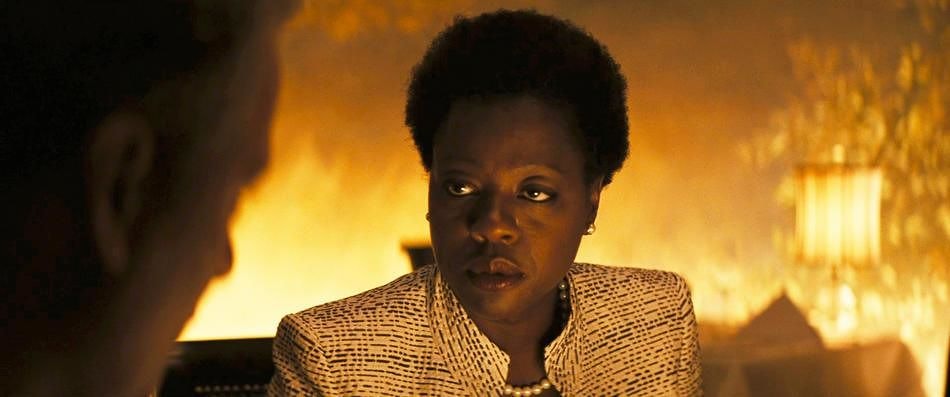
Does it have any positive depictions of women? No. All the female characters exist to be adjuncts to males except the unbelievable woman boss played by Viola Davis (waste of a great actress there)

Image result for suicide squad viola davis

and the Enchantress. Even the Enchantress feels the need to get her brother to help her out as she can’t quite manage on her own. Not impressive.

Related image

Is Jared Leto as the Joker any good? No, he really sucks. He has zero charisma, really not OK for an archvillain. Maybe that’s why he’s not in it much. Get someone else to play Joker next time. I’d like to see someone make the love story of Joker and Harley convincing – it so wasn’t.

This is a pig’s breakfast of a movie whose time in development hell pretty much rendered it unsalvageable. And yet… they managed to pull out something to put on the screen that was watchable. And it might not be going too far to say that this is almost entirely because of the enormous effort put in by Margot Robbie and her sheer talent and star quality. Will Smith does a very solid job and also deserves a bit of commendation for his work on helping this movie along.

Cabin in the Woods


Related image

Finally I caught up with this. And it wasn’t what I expected at all. I was expecting a satire on monster movies rather than an actual monster movie with satire sprinkles, and at the point where it was revealed that the monsters were indeed actual monsters I confess to being a little disappointed.

The idea of the archetypal figures needed for sacrifice was great and I was able to get on board for the monster fun in the end and enjoy the film for what it was.  It comes close to being a movie length/budget episode of Buffy. The best character who lands up in the Cabin is allowed to show a little more brain than the rest, if only because of his stoner habits, so was a sort of reverse Shaggy. The others were pretty unmemorable. Worth a watch, but don’t expect too much. Wish Whedon would commit at some time to not copping out on making a serious point or two. Finally, I was surprised at how highly rated this piece of fluff was on Rotten Tomatoes and that it had an R rating in the US. Have I seen a cut version on Netflix then?

Related image

A zombie from Cabin in the Woods

Ant Man

Considering its ill fortune with Edgar Wright leaving the production so late in the day the movie worked pretty well. It was entertaining and had enough thrills and stunts to keep me watching without getting bored.  The giant bathtub  probably looked even more impressive on a cinema screen, while I was watching at home on Netflix. I’d never read the comics and didn’t think a shrinking man had that much potential, but full imagination was used here and lots of fast and furious action goes on as the new Ant man trains to use his suit powers. Liked this bit.

https://www.youtube.com/watch?v=QRm6ky59cUU

The movie was noticeably white for the present day Marvel universe and I wondered whether Falcon had been included for racial balance. Good fight scene anyway.

Related image

And as for the women, there is Wasp seen in flashback

Related image

but we are going to have to wait for next time as one Wasp is dead and the other yet to be…also it occurs to me that being a super heroine by being the inventor’s wife/daughter is a bit retro.

I rather like Evangeline Lilley

Related image


and look forward to her being Wasp. Hope she loses this terrible hair though, that looks like a bad wig.

Related image
There was supposed to be a moral question about burying inventions to spare the world, to give the film a centre (essential) but it was muddied and lost. What came across to me was ‘OK you might decide this tech is dangerous but so what , someone’s going to use it one day anyway so it might as well be you. (So, the right to bear arms etc).’  Could this be what Wright argued with them about? I’d love to know. Solid supporting work from barely recognisable bearded Michael Douglas as Hank Pym the original Ant Man/inventor

Related image


Baby Driver

Related image

This movie left me ecstatic. Just magnificent. So much visual fun and games, and all set to music. Edgar Wright does not need the likes of Marvel telling him how to make his movies. Baby Driver beats any of their offerings easily and I expect it to be up to its ears in awards. Since I saw it all I want to do is see it again and have already got the soundtrack. I’d say it’s right inside my head, like only a few things get right inside my head. (Ask me in two years, I probably won’t remember, because I get these infatuations. I know it’s a piece of entertaining trivia without any serious message but wow).

Ansel Elgort. Does he have a great future? Probably. I’m hoping this doesn’t turn out to be his finest hour because I see potential. No one can tell how it will go when you get launched into the world like this. Ansel, I’d like to think you’re old enough and bright enough to cope with the fame and not end up doing the drugs and debauchery thing.

https://tenor.com/view/baby-driver-movie-baby-driver-baby-driver-gifs-ansel-elgort-look-up-gif-8501686

Image result for joseph baby's foster father baby driver

I didn’t know much about John Hamm as I’d barely seen him in Mad Men. But his acting was more than enough here. Hamm as Buddy made a great antagonist for Baby and both of them were excellent. The other bad guys were a little underwritten and lacking in interest for me so I won’t judge their performances since they weren’t given much to work with. I think Bats should  have been a bit more interesting to work as a false antagonist.

Related image

Baby’s black deaf foster dad, played by deaf actor C J Jones – well you could arguably have left him out of the movie altogether but I’m glad he was there, it was all very warm and touching and added to Baby’s character. I hope Baby doesn’t just forget him in that old folks’ home. Was he still alive by the end of the movie? I think we are supposed to have forgotten him and think that the home was his happy ending but surely they would miss each other.  

Related image

The big flaw in my book was Kevin Spacey as the gangster boss Doc who has Baby in his thrall. I felt no commitment to the role from him and to me his performance was lazy and phoned in. Even ‘laconic gangster’ has to be worked at. I get angry with actors who think they don’t need to try. I’d have sacked him if I’d been Edgar and got someone who cared. This was all such a pity as it was quite a big role. I didn’t find his confession to being ‘in love once’ at all convincing as there had been no sign of humanity or change of expression in him up to that point. That scene was always going to be corny but it could have worked better than it did with someone else in the role.

Related image

I can forget that though, amongst all the glorious rest of the movie.

Female presence: this is a boys’ movie and there are two female characters, the good one and the bad one.

Baby’s girlfriend Deborah is simply ‘a good woman’, although she does get to chalk one up for knowing T Rex is not pronounced ‘trex’ and is actually a bit older than him.


Related image
(I thought she looked familiar but only just realised she was Lady Rose in Downton Abbey ).

Buddy’s wife ‘Darling’ is a stereotypical gangster’s moll type in appearance and habits, although she is allowed to kick ass as much as the men and there are diversity points to be awarded for casting a Latin actress Eiza Gonzalez. Is Hamm really only 46? I think he lied about his age. She looks more than 20 years younger than him.

Related image


 Wright could not really be said to be a pioneer for women whatever else his genius.

The final minutes went against the norm for an action movie with the hero having to go through a (very easy) ‘purgatory’ stage to get to a true happy ending. How satisfying to know he made it back into society and got to be with his true love. But then I am both sentimental and a moralist so naturally I loved  all that. My worst fear at that point – a Thelma and Louise ending.  Really an irrational fear as EW would not do that kind of thing to us.

If I ever rent the Everyman to show a movie for my friends I believe I will choose this one.

A last thought. If we are going to have all electric cars in the future, what will a car chase/heist movie look and sound like? Maybe this is nostalgia in the making.