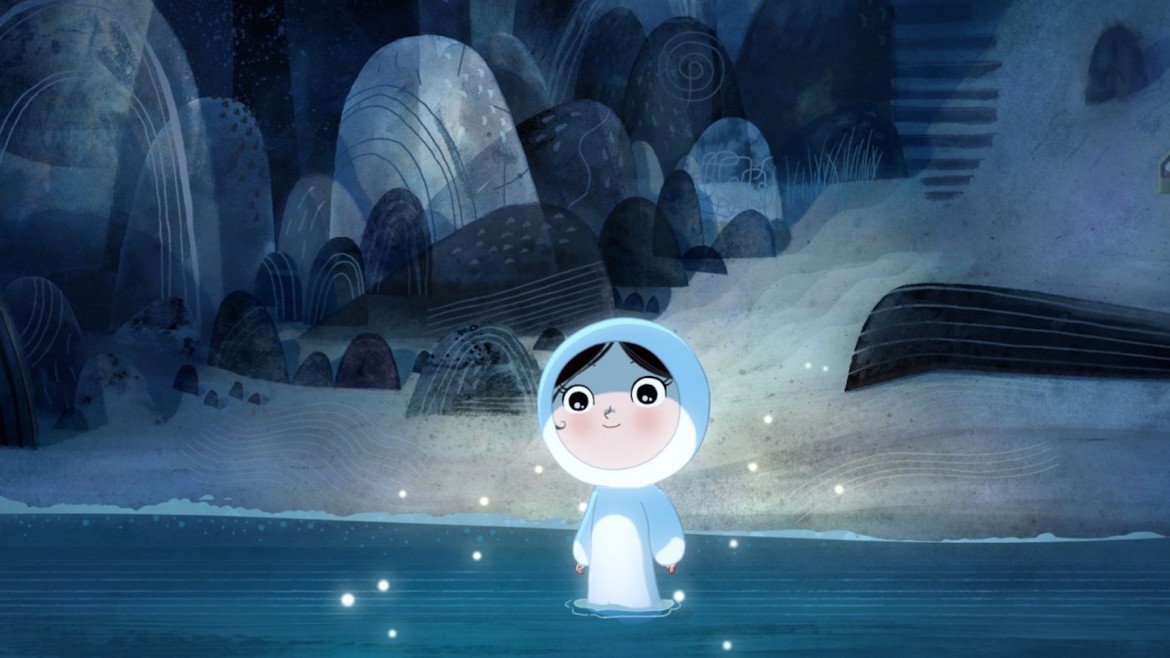
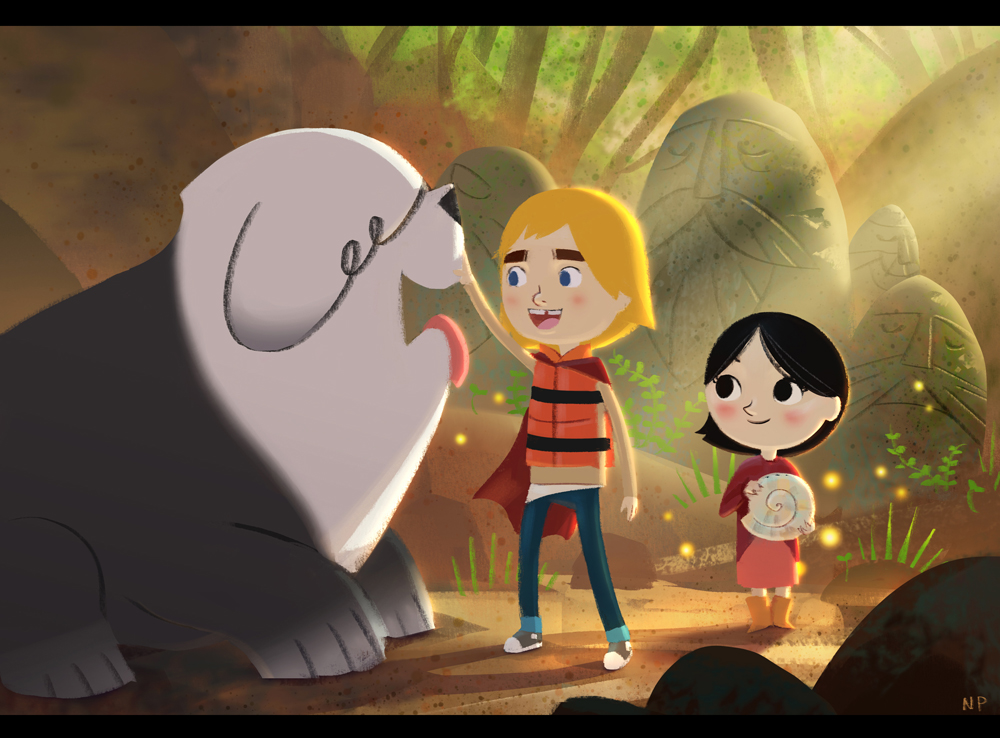
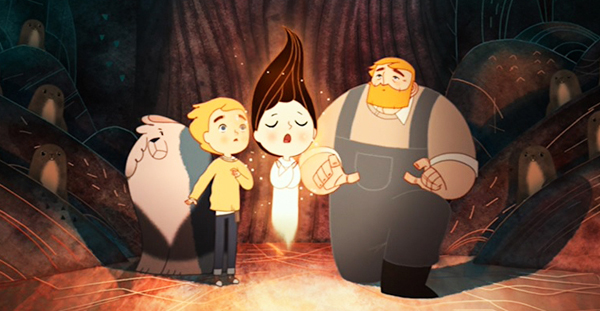
My husband discovered Song of the Sea when he was browsing Amazon Prime for something new to delight our three-year-old. She loves films and we have both had our fill of Frozen so we try to diversify wherever we can.
Disclaimer: Frozen is good. I know that Frozen is good. But I can act the whole thing out for my kid now. The. Whole. Thing.
It draws from myths of the Selkie - people that can change their form from seal to human by shedding their sealskin (much like a coat). The myths tend to revolve around human men forcing female selkies into relationships by stealing their sealskin.
This film does not do that. But it does play with ideas of love and loss, and the desperation that often ensues.
We meet Ben as a very young child. He and his mother are painting the walls in his room with characters from the stories that she has told him.
She is also very pregnant. She clearly loves Ben, and her husband. It appears to be an idyllic family. But then she becomes ill and runs into the sea where she disappears, leaving behind her baby, Saoirse (pronounced ser-sha), the last Selkie child.
Six years later, Ben's dad is emotionally disengaged, Saorsie has not yet spoken a single word, Ben resents her for the loss of his mother and he is terrified of drowning. So scared, that he always wears a life-vest. His only friend is his dog, Cu, who also loves and looks after Saorsie much to Ben's frustration.
In short - there is a lot that is broken in this family and in order to fix it, the characters must learn to move past their sorrow. To begin with, this means accepting it.
What a film for both children and adults alike.
I love the myths running through it and how the human and the faerie world collide, and how everyone effectively learns the same thing. That sorrow cannot be avoided, and that denying it turns us, bit by bit, to stone. That we must continue to love and hope and dream and to care for one another despite our fears.
Ultimately, the characters are all restored and even though Ben's mother can never return, he has his family back.
It is exceptionally well written and voiced, and beautifully animated. If you want to try something a little bit different, I cannot recommend this enough. My three-year-old loves it so much that when it dropped from Amazon Prime's listing, we went ahead and bought it. Sometimes, she even opts to watch it over Frozen.
(Warning: contains spoilers about The Lego Batman Movie)
When a film has a break out star, a cry almost always goes up that they should have their own film/television programme/breakfast cereal. This is risky because too much of a good thing can quickly become tiring. In recent years, breakout stars have included Captain Jack Sparrow (the Pirates of the Caribbean franchise) and the Minions (the Despicable Me franchise). Arguably, we are already seeing diminishing returns for both (to the extent that an audible groan could almost be heard when Johnny Depp announced his intention to star in the 5th Pirates film).
The Lego Movie came out 3 years ago (Really? 3 years already?) to near-unanimous critical and box-office acclaim, and Batman became one of the stand-out characters. And, as the opening paragraph would suggest, now here we are with the spin off: The Lego Batman Movie.
Coming your way to a cinema near you
The plot is fairly simple. Commissioner Gordon is retiring and his daughter (Barbara) is taking over his role. Rightly pointing out that despite his vigilantism, Gotham City remains the city with the highest levels of crime ever. She suggests that the police stop working with Batman, and that the police should try the new tactics of being "accountable and extra legal". Batman is displeased and strops off to be by himself in his BatCave eating microwaved lobster thermidore, playing electric guitar and watching Jerry Maguire. And accidentally adopting a child, because he wasn't paying attention. After hurting the Joker's feelings by suggesting that he isn't his number one nemesis (a kind of love/hate bromance where Batman refuses to commit), the Joker releases everyone from the Phantom Zone (a kind of Guantanamo Bay for villains including Voldemort, King Kong, Sauron, Agent Smith and the Wicked Witch of the West. And British robots. Which aren't Daleks.) Chaos ensues.
Notably, there are no references to The Lego Movie. If anything, this is a sequel to the Batman films, and arguably should stand in its canon. Certainly, it is an antidote to the noir Batman movies of Christopher Nolan and Zach Snyder. Maybe audiences have tired of brooding superheroes with their increasingly dark plotlines for now - the crowd pleasers seem to be the more irreverent and meta Avengers (and their component individual character movies) and Deadpool. Or (and I'm just throwing this out there), maybe audiences are just responding positively to scripts and characters that aren't dreadful (*awkward cough* Suicide Squad, Batman Vs Superman *awkward cough*).
There are themes worth exploring - Batman/Bruce Wayne fears intimacy after the death of his parents and lacks purpose when his job (and with it, his identity) is taken from him. His relationship with Alfred. ("I've seen you in this mood before in 2016, 2012, 2008, 2005, 1997, 1995, 1992, 1989 and that weird time in 1966"). The importance of family. Loneliness. And those themes are explored well, without hanging heavily.
It's worth seeing this film at the cinema, and being slightly overwhelmed by the colour and noise of it all. Films like this benefit from a big screen, and from multiple viewings. Lego is a cross-generational toy, and it makes sense that the film should be a cross-generational movie. So while the kids in the screening I saw laughed at Dick Grayson ripping off his pants ("RRRIIIIIPPP"), the reference to the films at Gotham Multiplex (Two Shades of Grey) might have passed them by. And...it makes Bane better.
He was born in the darkness. Apparently.
It lacks a little bit of something (perhaps the innocence of The Lego Movie), but it is a heavy dollop of Batman and makes up for a lot of Batman Vs Superman. A little less Everything is Awesome, but Everything is Cool if You're Part of a Team. Pow! Bang!
Additional thoughts, comments and questions:
Excellent voice casting, particularly from Will Arnett as a gravel-voiced, Bale-type Batman. Ralph Fiennes also excellent casting as Alfred, though an odd decision given that Lord Voldemort is also in this film (voiced by Eddie Izzard). Maybe a licensing issue?
Nice line from Barbara Gordon "you could be Batgirl!" "Please! I would be Batwoman."
Best (and surprisingly moving) use of One is the Loneliest Number since Magnolia.
Do all animated films now start with a film short?
(Warning: contains spoilers for Moana, and probably a whole lot of other Disney films)
We are in the middle of a new age of Disney. You must have noticed - that suddenly even the harshest critics are grudgingly admitting that Let It Go is a pretty catchy tune and that Zootropolis was one of the better films of 2016 (yes, it was about bunnies but it also had Breaking Bad references). Actually we're in the middle of the fourth Disney-era, commonly known as the Disney Revival Era. There's been the Golden Age (everything from 1937 to the 80s, including Cinderella, Sleeping Beauty etc), the Renaissance Era (everything from 1989-99 including Beauty and the Beast, The Lion King, Aladdin), the Post-Renaissance Era (2000-07, ending with the merger with Pixar, films including Tarzan and Lilo and Stitch), and now the Disney Revival Era (2008 to date, including Tangled, Frozen, Big Hero 6).
To me, the interesting thing about the Disney Revival Era is the correction of popularly held tropes from Golden era Disney. Where Cinderella teaches that if you wish hard enough and just sit there, all your dreams will magically come true, The Princess and the Frog teaches that having a dream is fine, but you'll have to work for it. Where Sleeping Beauty emphasises the importance of true love, Frozen allows that true love can, in fact, come from your family and maybe you shouldn't agree to marry the first man you sing a song with if you don't know anything else about him. Disney women in the 21st century are tougher and more independent creatures, and that's part of the reason why there's currently a petition to have Princess Leia added to that pantheon of princesses.
Into that mix comes Moana, which is the story of a Polynesian tribal heir who is chosen to restore the heart of the goddess Te Fiti, and thus restore the failing fortunes of her tribe's island. There is the usual singing and dancing, but there's a number of notable key features:
Two sidekicks! And that little turtle from Finding Nemo!
1. No love interest
This is unusual. Moana is the 56th animated Disney film but the last film where the main character was female and human and had no love interest was 2002's Lilo and Stitch. There isn't even the mention of wanting a partner, it's just not an issue ("but she's only 16, Caroline!" "yes, but so was Ariel, and Jasmine was only 15.").
2. Both parents survive
Hey, you just couldn't wait to be king...
Parents don't do well in Disney films. Main characters are usually orphans (e.g. Aladdin), or one parent has remarried (usually after the death of the first, usually the mother - e.g. Snow White), or one parent dies during the film (e.g. Mufasa). In the past 20 films, I think there might be just three instances where the main character comes from a two-parent family who begin and end the film together. I will buy a Disney film for the first person who can name them. But Moana has two parents, who are still alive by the time the credits roll. Hurrah!
3. Non-white culture
There's not a lot of diversity in Disney. Human heroines tend to be Caucasian and skinny with long straight hair. Moana shares a platform with Lilo and Pocahontas as being a main character with a different kind of body type. Excellent. More of this, please.
The references to Moana's culture are interesting - we learn of their community way of life, their references to their ancestors and their heritage, and the significance of their tattoos. More importantly, we learn about these things in a way that feels organic, rather than heavy-handed.
4. Compromise
Disney is full of independent women who want to defy their parent(s) and live out their own dream, but this usually manifests in the parents learning that the kids are right and should go and do their thing. I can't think of any examples outside of Moana where the hero manages to balance their dreams with their responsibilities. Ariel went off and lived in the human world, Sleeping Beauty married the man of her dreams (who accidentally happened to be her betrothed). Moana gets to explore life outside the reef as a wayfarer (what she wanted), while also leading her tribe (what her parents wanted). Fair play.
But the thing that particularly interested me - Restorative Justice in a Disney film. Actually, Restorative Justice at all in a film. Maui recognises the harm that he has done to Te Fiti, apologises and makes it right in a way that is acceptable to Te Fiti. This pleases me.
This is a film worth seeing. It's full of positive messages, redresses some unhelpful Disney tropes, and seems to directly reference Mad Max: Fury Road, while there's a giant crab who sings like David Bowie. What'snot to like?
I like Roald Dahl.He
has a fantastic way of using made up words which are more expressive and
explanatory than the “proper” ones.He
has a way of appealing to the imaginations of kids (and big kids) in a way that
means his stories and suggestions stick with you throughout life.In “Boy”, he writes about how he used to
believe that liquorice was made by boiling and steamrollering the rats that
would be caught in factories.In “The
Witches”, he describes the telltale signs of how to spot a witch (they have
unfeasibly pointy shoes because they have no toes, they’re always scratching
their heads because they’re bald and wear wigs, they wear long gloves because
their fingernails are long and pointy and grow very fast), meaning that readers
start looking with suspicion at shoes, at gloves, at hats.Steven Moffatt is a master of this – his
episodes of Doctor Who mean that viewers now have a very different relationship
with shadows, statues and the dust in sunbeams.
Don't blink...
The opening scenes of Steven Spielberg’s The BFG are like this.We see Mark Rylance’s eponymous giant move
around late night London completely unseen, hopping onto the back of a parked
truck to look like a pile of masonry, pulling his cloak across the gap between
buildings to look like the entrance to a building site.Does it look like there’s an extra lamppost
in your street?Might be the BFG.Are the trees rustling?Or is it the BFG.
For those unfamiliar with the story, Sophie is a sad and
neglected orphan who happens upon a Big Friendly Giant (BFG) one night and he
whisks her away to Giant Country, where she learns that he is the only
non-cannibalistic giant there is.He
protects her from the other giants (with typically Dahllian names as
Fleshlumpeater and Bone Cruncher) and teaches her the secrets of catching
dreams and blowing them through the bedroom windows of sleeping children.
In 1989, The BFG was made into an animated film
I found a dream in London...(part of the BFG Dream Trail)
by Cosgrove
Hall (their only animated film) and it balanced whimsy and horror brilliantly.For every flash of Fleshlumpeater’s long,
sharpened fingernail poking in through a sleeping child’s window, there was a
sequence in Dream Country where Sophie and the BFG tried to catch squirming
dreams, or drank fizzy Frobscottle and flew on their explosive farts (Dahl
really knew how to appeal to kids!).The
most chilling part of that film, for me, was the Queen reading the headlines:
“Tragic horror as children slain.Bones
found beneath dormitory windows“.The
film has rightly become a cult classic.Bizarrely, you can watch the entire thing on YouTube.
"This is Dream Country. This is where all dreams is beginning"
In 2016, we have the Spielberg version. Spielberg has a brilliant mind for appealing
to kids, and Dahl and Spielberg should be a match made in heaven.And it almost is.Dream Country is there and looks beautiful –
the dreams are colourful, tangible things that dash around the screen like
Tinkerbell.Snozzcumbers are revolting,
warty, maggoty looking vegetables (the BFG’s only food, but necessary for
making Frobscottle).The fart jokes are
there in abundance (*snigger*).John
Williams’ score is magnificent, and (as always) captures the chaos, mischief
and wonder (it’s reminiscent of Maggie’s song from Hook) that seems to be specific to the children’s films he works on
(see also: Harry Potter, ET).And Mark Rylance is an excellent Big Friendly
Giant, childish and lonely with sad eyes, wanting to make the world a little
better with beautiful dreams.For me,
what this film lacks is a little bit of horror.It all feels very safe.There’s
hints towards it, but it’s adult horror – the BFG has had a child living with
him before and Sophie finds his clothes – a little red jacket – and his
drawings, but doesn’t particularly question it.The assumption is that this child met with a chewy end at the hands of
the “canningball giants”.The nightmare
set upon those giants is an adult one: “Looks at what you has done – there is
no forgiveness”.Dahl appealed directly
to children – the humour is for children, the horror is for children.Spielberg has captured one, but shied away from
the other.
Fleshlumpeater...
This begs an interesting question, and I throw it open
because I’m interested.Is there room
for horror for children?Should children
be scared?I’m not saying to throw them
in a cellar full of rats, or chase them with knives, or make them watch endless
loops of Thomas and the Magic Railroad.If we want children to use their imaginations
(we still want that, don’t we?), can we limit that imagination to only the good
things, and protect from the bad?
Disney animation has always been a staple part of my upbringing. If I think hard about my
childhood, I remember (amongst other things) Christmases involving a new packet of VHS blank
tapes, upon which as many Disney feature films were recorded as the holiday season would allow.
To this day, I expect certain films to pause for the adverts, Alice in Wonderland to be immediately
preceded by the Queen’s Speech, and Mary Poppins to cut out part way through from where the
plug got knocked out of the VCR mid-recording.
So it should come as no surprise that my first trips to the cinema were to watch Disney films. The
first film I saw – certainly the first I remember seeing - was Pinocchio. I can’t quite work out when
this would have been – the internet suggests it was in 1984 but given that would have meant I was 2,
I’m not sure that’s right. Disney’s standard procedure for theatrical release was that a film would be
released in the cinema, and then rereleased once every 10 years or so. Every so often, there would
be an announcement that something was being screened for the final time. Which seems like a very alien concept in 2016.
Pinocchio was first released in 1940, and is the second animation produced by Disney (and the first
ever Disney animation to be released on VHS). It won two Oscars (Best Music – Original Score, Best
Music – Original Song) but was initially a commercial disaster until its rereleases. It’s now regarded
as one of the greatest animated films ever, as evidenced by its 100% rating on Rotten Tomatoes, its
inclusion on a number of lists of “Best Film”, and its ongoing storytelling legacy (lies make your nose grow, your conscience is a physical entity with corporeal form). Its Oscar winning song (When You Wish Upon a Star) is currently the opening music to every Disney (and Pixar) film, and in my brain may as well be the shorthand for “you’re about to see something absolutely fantastic”.
This makes me so happy. Every time.
Which of course I cared deeply about when my age was still in single digits.
I assume I must have gone with my parents – definitely my dad. And I definitely had a Mr Man Mr
Strong strawberry ice lolly. And I definitely dropped it on my cinema seat and spent most of the film
sitting on the armrest while it melted. I do remember the smell of the cinema, which hasn’t changed
that much in all my cinema-going years (warm popcorn). That an episode of The Wuzzles was shown before the film, that…hold on, actually, let’s take a moment and talk about The Wuzzles. It was a series of short cartoons about creatures which were made out of combinations of different animals. Like Rhiokey, which was an amalgamation of a Rhinoceros and a Monkey. I loved The Wuzzles. They lived on the imaginatively named island of Wuz, and they all had wings, although not all of them flew. I loved Butterbear (part Butterfly, part Bear) and Bumblelion (part Bee, part Lion – because these are all animals that needed splicing together?). I cannot remember the theme tune, but YouTube helpfully informs me that it sounded like this:
It rings absolutely no bells for me, but sings happily about
“originality…living with a split personality”. No one ever remembers the Wuzzles…
I’ve become distracted by YouTube videos of 80s cartoons. This was a mistake…
I rewatched Pinocchio last year and was surprised by the following things:
a) How quickly it zips along
It really packs a lot into 88 minutes. Yet I distinctly remember there being a break halfway
through the film (I got my doomed Mr Strong ice lolly from the usherette). Why was there a
break in a film that was less than an hour and a half long? Hmm…
b) It’s a beautiful piece of work
And worth remembering that people drew it. By hand. Frame by frame. That’s a skill I can
never hope to achieve.
Look at that. It's fantastic.
c) It’s TERRIFYING!
Ah Disney – so light, so fluffy, so innocent and sweet. The first time Pinocchio leaves the
house, he gets kidnapped by a talking fox who sells him into slavery to a travelling showman
who locks him in a cage, refuses to pay him, and threatens to turn him into firewood if he
talks back.
After Pinocchio escapes, the same fox trafficks him to Pleasure Island where unruly boys are
encouraged to drink beer, smoke cigars, break windows and play pool (not really sure why
pool is a big deal, but okay then). And when they do, they turn into donkeys and are sold.
The transformation in this is frightening. The undercurrent of it all is horrific (the Coachman
strips the clothes off the donkeys who can no longer speak, and sells them on. The boys
who look like donkeys but can still speak are separated out – WHAT HAPPENS THEM???)
Take a moment, watch this, think about the youngest child you know and remember that this is a scene from a "U" rated film...
After Pinocchio escapes that, he discovers his father has gone looking for him, and been
swallowed by a whale. So he rescues his father and then dies in the attempt.
He DIES! Dead! Yes, he becomes a real boy, but not before his father brings him home lays
him out, and he, Pinocchio’s conscience and the family pets cry over his disfigured corpse.
At this point, all his father had ever wished for was for Pinocchio to become a real boy. And
as soon as he went into the real world, nothing is safe for Pinocchio again.
There are FIVE bad guys (Honest John, Gideon, Stromboli, the Coachman and Monstro).
FIVE! There is trafficking, slavery, and abuse. And all of them get away with it. There is no
retribution, there is no comeuppance. We believe Disney sells happy ever after, but it’s
more sinister than that – it’s only happy ever after for some.
And suddenly that Oscar winning song is so much more ominous when you consider that all
the characters must wish…
_poster.jpg)